Non-Resident Tax Rates in Australia: What Foreign Residents Pay
Non-residents for Australian tax purposes pay 30% tax on every dollar earned in Australia up to $135,000 — with no tax-free threshold at all. This is the single biggest difference from resident tax: an Australian resident pays nothing on their first $18,200, but a foreign resident is taxed from the very first dollar.
This guide covers the 2026–27 non-resident tax brackets, how they compare to resident rates in dollar terms, what happens with the Medicare levy, and how working holiday makers fit into a separate system again.
Key Takeaways
- Foreign residents pay 30% on income up to $135,000, 37% up to $190,000, and 45% above that — for the 2026–27 financial year.
- There is no tax-free threshold and no Low Income Tax Offset for foreign residents.
- Foreign residents generally don’t pay the 2% Medicare levy, since they’re usually not eligible for Medicare.
- Working holiday makers (visa subclasses 417 and 462) sit under their own separate schedule, taxed at 15% on the first $45,000.
- Residency for tax purposes is decided by the ATO’s residency tests — not by the visa a person holds.
The 2026–27 Non-Resident Tax Brackets
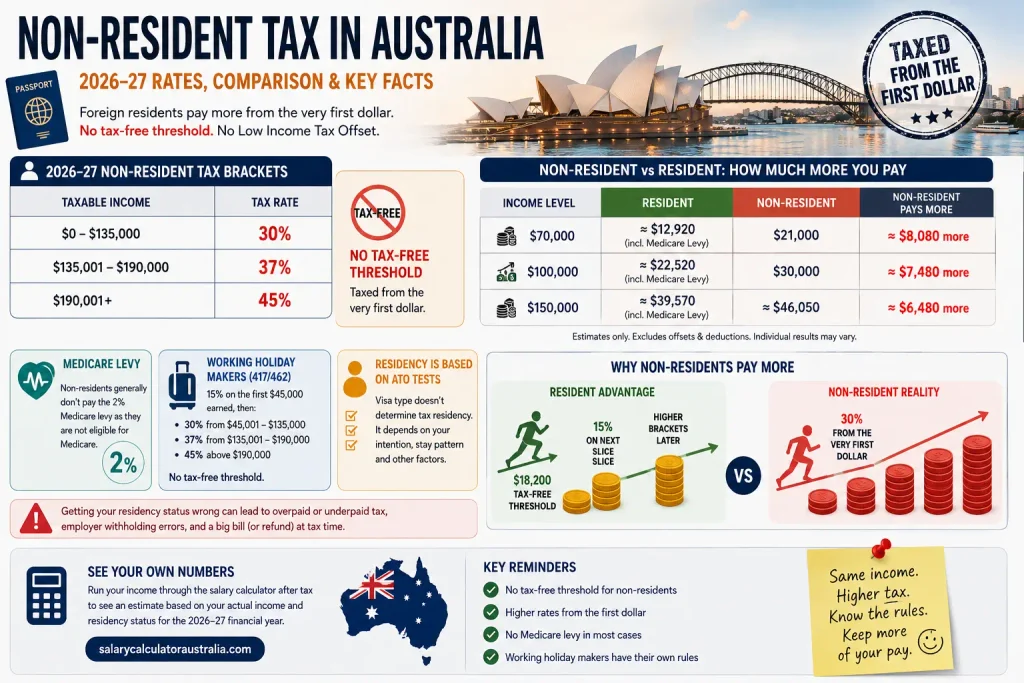
For the 2026–27 financial year, foreign residents are taxed as follows: 30% on taxable income up to $135,000, 37% on the portion from $135,001 to $190,000, and 45% on anything above $190,000. Unlike the resident scale, there’s no 0% or 15% band at the bottom — the 30% rate applies from the first dollar of Australian-sourced income.
This structure hasn’t shifted with the recent resident tax cuts. The resident second bracket dropped from 16% to 15% from 1 July 2026, but that change only affects the $18,201–$45,000 band — a band non-residents never had in the first place. Non-resident rates are unaffected by that cut.
Why Non-Residents Pay More at the Same Income
Because residents get the $18,200 tax-free threshold plus a lower 15% rate on the next slice of income, while non-residents start at 30% straight away, the gap between what a resident and a non-resident pay on identical Australian income can be substantial — even before accounting for the Medicare levy residents also pay.
At $70,000 income (2026–27): A resident pays roughly $11,520 in income tax plus a Medicare levy of about $1,400 — total around $12,920. A non-resident pays a flat $21,000, since the entire $70,000 sits within the 30% band. That’s roughly $8,000 more for the non-resident, despite earning the same amount.
At $100,000 income: A resident pays roughly $20,520 in income tax plus a Medicare levy of about $2,000 — total around $22,520. A non-resident pays $30,000 flat. That’s around $7,500 more.
At $150,000 income: A resident pays roughly $36,570 in income tax plus a Medicare levy of about $3,000 — total around $39,570. A non-resident pays about $46,050, since $135,000 of that income sits in the 30% band and the remaining $15,000 moves into the 37% band. That’s around $6,500 more.
These figures are estimates based on the published brackets, exclude offsets and deductions, and are for comparison only — actual liability depends on individual circumstances.
What About the Medicare Levy?
Foreign residents generally don’t pay the 2% Medicare levy, because Medicare eligibility is tied to residency and most non-residents aren’t eligible for Medicare benefits in the first place. This partly offsets the higher income tax rate, though it rarely closes the gap entirely, as the worked examples above show.
Someone whose residency status changes partway through a financial year — becoming a non-resident partway through, for instance — may need a Medicare Entitlement Statement to confirm their exemption period, since eligibility isn’t automatic just because someone leaves the country.
Working Holiday Makers Are a Separate Category
Working holiday makers on a 417 or 462 visa aren’t taxed under either the resident or the standard non-resident scale. Instead, they have their own bracket: 15% on the first $45,000 earned, with resident-equivalent rates applying above that — 30% from $45,001 to $135,000, 37% from $135,001 to $190,000, and 45% above $190,000. Like non-residents, working holiday makers don’t receive the tax-free threshold.
This working holiday maker rate only applies while an employer is registered to withhold at that rate for an eligible visa holder. Where that registration doesn’t apply, the standard non-resident rate is used instead.
How Residency Is Actually Determined
Whether someone is taxed as a resident, a non-resident, or a working holiday maker comes down to the ATO’s residency tests for tax purposes — not the type of visa held, and not simply where someone happens to be living when they lodge a return. Someone can hold a working visa and still be assessed as an Australian tax resident, or vice versa, depending on factors like the intention and pattern of their stay.
Getting this classification wrong has real consequences: an employer applying resident withholding to a non-resident employee — or the reverse — is a common payroll error that creates a gap to settle at tax time, in either direction.
See How This Affects Your Own Pay
Non-resident tax has no tax-free threshold to factor in, but it interacts with pay frequency, super, and any Australian-sourced side income the same way resident tax does. Run the numbers through the salary calculator after tax above to see an estimate based on your actual income and residency status for the current financial year.
FAQ Section
Do non-residents get the tax-free threshold in Australia?
No. Foreign residents are taxed from the first dollar of Australian-sourced income, with no $18,200 tax-free threshold and no Low Income Tax Offset.
What is the non-resident tax rate in Australia for 2026–27?
30% on taxable income up to $135,000, 37% from $135,001 to $190,000, and 45% above $190,000.
Do non-residents pay the Medicare levy?
Generally no, since most foreign residents aren’t eligible for Medicare. Some circumstances may still require confirming an exemption period.
How is working holiday maker tax different from non-resident tax?
Working holiday makers (417/462 visas) are taxed at 15% on the first $45,000, then align with the higher non-resident-equivalent brackets above that — a lower starting rate than the standard 30% non-resident rate.
Has the 2026–27 tax cut changed non-resident rates?
No. The recent cut to the second resident bracket (16% to 15%) only affects the resident $18,201–$45,000 band, which non-residents were never taxed under.