Marginal vs Effective Tax Rate Australia: What’s the Difference?
Written by: Salary Calculator Australia Editorial Team · Fact-checked against: ATO 2026–27 tax rates, Medicare levy and HELP thresholds · Last reviewed: October 2026
Your marginal tax rate is the rate applied to your next dollar of income. Your effective tax rate is the average rate you actually pay across all of it — and the two numbers are almost never the same. Mixing them up is one of the most common tax misunderstandings in Australia, and it leads people to overestimate how much of a pay rise or bonus they’ll actually lose to tax.
This guide breaks down what each rate measures, why your effective rate is always lower than your marginal rate, and walks through real numbers at three income levels for the 2026–27 financial year.
Key Takeaways
- Marginal tax rate: the rate charged on your next dollar of income — the top bracket your income reaches.
- Effective tax rate: your total tax divided by your total income — the average rate across everything you earned.
- Because Australia’s tax system is progressive, your effective rate is always lower than your marginal rate.
- At $200,000 income in 2026–27, the marginal rate is 45%, but the effective rate (including Medicare) sits around 30%.
- A pay rise or bonus is only taxed at your marginal rate on the amount above your current bracket — never on your whole income.
What Is the Marginal Tax Rate?
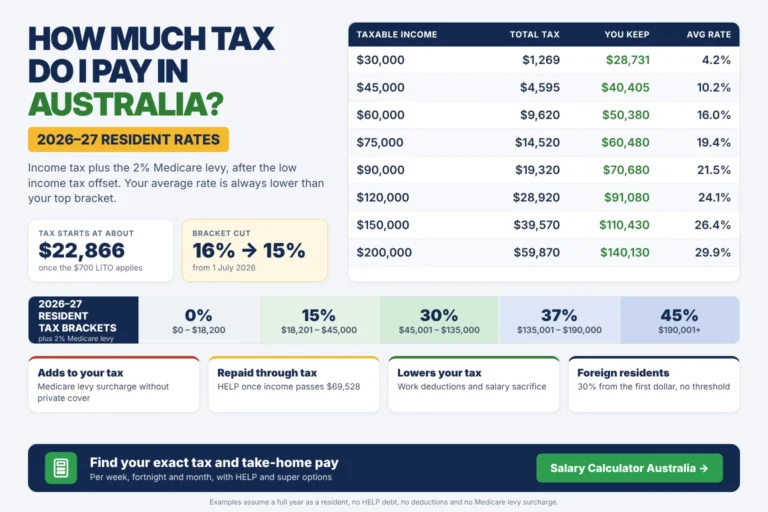
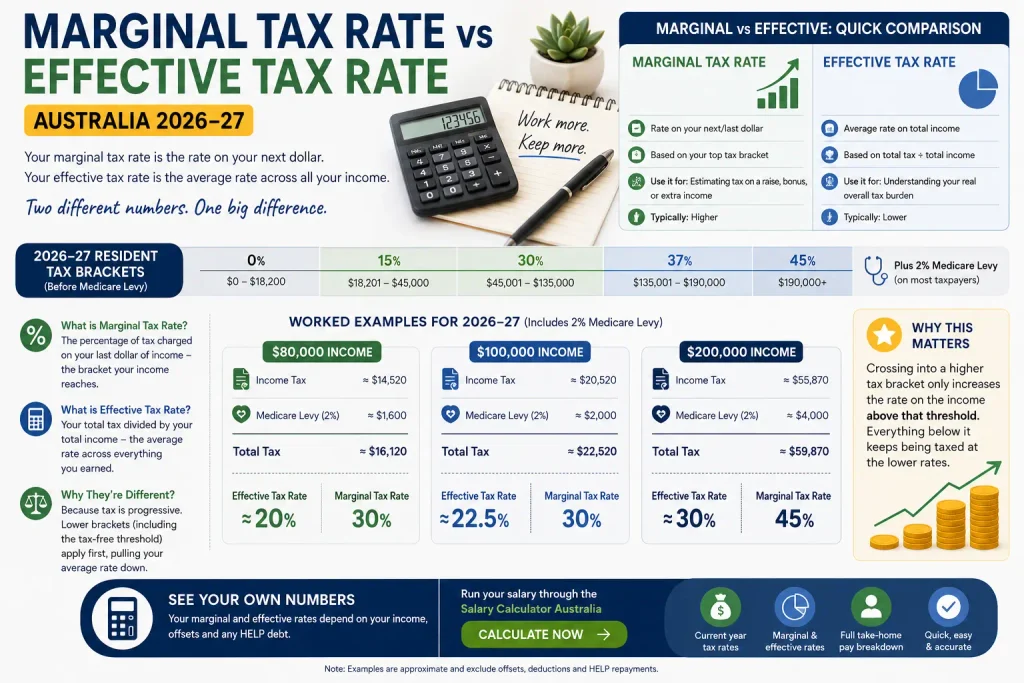
The marginal tax rate is the percentage of tax charged on the last dollar you earn — whichever bracket your top slice of income falls into. Under Australia’s 2026–27 resident tax brackets, income is taxed progressively: 0% up to $18,200, 15% from $18,201 to $45,000, 30% from $45,001 to $135,000, 37% from $135,001 to $190,000, and 45% above $190,000. These figures sit before the separate 2% Medicare levy that most residents also pay.
Each rate applies only to the slice of income that falls inside that bracket — not to your entire salary. Someone earning $100,000 doesn’t pay 30% on all $100,000; they pay 30% only on the portion above $45,000. For the dollar amounts at common salaries, see how much tax you pay in Australia.
What Is the Effective Tax Rate?
The effective tax rate is your total tax bill divided by your total income, expressed as a percentage. It blends every bracket you passed through — including the tax-free portion — into a single average figure, which is why it’s always lower than your marginal rate once you’re earning above the tax-free threshold.
This is the number that actually reflects how much of your income goes to tax overall. Your marginal rate tells you what happens to your next dollar; your effective rate tells you what happened to all of them.
Why the Two Numbers Are Always Different
Because tax brackets stack progressively, every dollar you earn passes through the lower brackets before it reaches your top one. The $18,200 tax-free threshold, the 15% band, and the 30% band all get applied before a higher-income earner’s income reaches the 37% or 45% brackets. Averaging tax paid across all of these lower rates pulls the effective rate well below the marginal one — the higher your income climbs past a bracket boundary, the wider that gap tends to get, at least up to a point.
Worked Examples for 2026–27
These examples use the 2026–27 resident tax brackets plus the 2% Medicare levy, and assume no offsets, deductions or HELP debt, so actual outcomes will vary by individual circumstances.
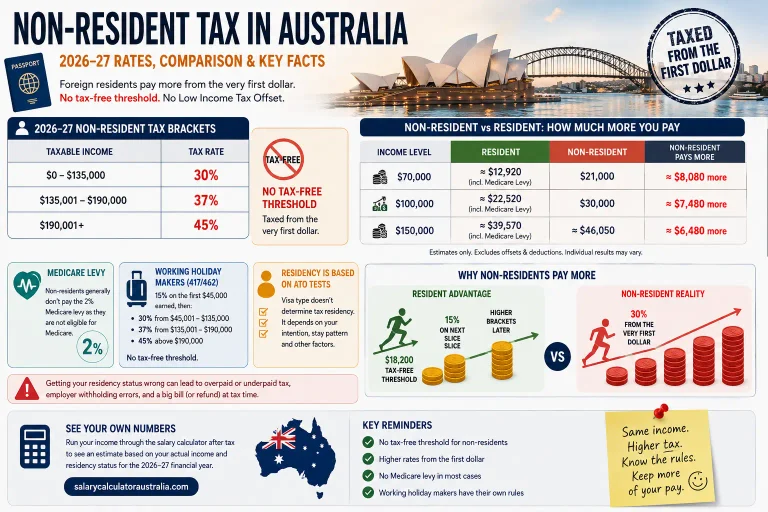
Tax rates also differ depending on residency status; non-resident tax rates in Australia follow a separate schedule.
$80,000 income Income tax works out to roughly $14,520, plus a Medicare levy of about $1,600 — total tax near $16,120. That’s an effective rate of about 20%, even though the marginal rate at this income is 30%.
$100,000 income Income tax comes to roughly $20,520, plus a Medicare levy of about $2,000 — total tax near $22,520. That’s an effective rate of about 22.5%, again against a 30% marginal rate.
$200,000 income Income tax works out to roughly $55,870, plus a Medicare levy of about $4,000 — total tax near $59,870. That’s an effective rate of about 30%, despite a top marginal rate of 45%.
The pattern holds across all three: the marginal rate describes the tax bracket you’ve reached, but the effective rate describes what you actually hand over as a share of everything you earned.
Why This Matters for Pay Rises and Bonuses
A common worry is that moving into a higher tax bracket means losing a bigger share of your entire income to tax. That’s not how it works. Crossing into a new bracket only raises the rate on the income above that threshold — everything below it keeps being taxed at the lower rates it already fell into.
A pay rise that pushes part of your income into the 37% bracket, for example, doesn’t touch the tax already applied to the portions sitting in the 0%, 15% and 30% bands. The extra tax applies only to the new, higher slice — which is also why a bonus or overtime payment is never taxed at a punishing “extra” rate, even though the amount withheld from that specific payment can look higher in the short term. Our fortnightly pay calculator shows how much of a rise you actually keep each payday.
Marginal Rate vs Effective Rate: Quick Comparison
| Marginal Tax Rate | Effective Tax Rate | |
|---|---|---|
| What it measures | Rate on your next/last dollar | Average rate on total income |
| Based on | Your top tax bracket | Total tax ÷ total income |
| Use it for | Estimating tax on a raise, bonus, or extra income | Understanding your real overall tax burden |
| Typically | Higher | Lower |
See Your Own Numbers
Bracket tables and averages are useful for understanding the mechanics, but your own marginal and effective rates depend on your exact income, offsets and any HELP debt. Run your salary through the salary calculator australia to see both figures calculated against the current financial year’s rates, alongside your full take-home pay breakdown.
FAQ Section
What is the difference between marginal and effective tax rate?
Marginal tax rate is the rate applied to your next dollar of income — your top bracket. Effective tax rate is your total tax divided by your total income — the average rate across everything you earned.
Why is my effective tax rate lower than my marginal tax rate?
Because Australia’s tax system is progressive: lower brackets, including the tax-free threshold, apply to earlier portions of your income before any higher rate kicks in on the top slice. Averaging across all of these brings your effective rate down.
Does a pay rise mean I pay more tax on my whole salary?
No. Moving into a higher bracket only increases the rate on the income above that bracket’s threshold. Income already taxed at lower rates stays taxed at those lower rates.
What is the top marginal tax rate in Australia?
For 2026–27, the top marginal rate is 45% on taxable income above $190,000, before the 2% Medicare levy.
Is bonus or overtime income taxed at a higher rate?
No. It’s added to income for the pay cycle it lands in, which can temporarily increase withholding, but it isn’t taxed at a punitive rate — the correct amount is reconciled against your actual marginal rate at tax time.
How do I calculate my own effective tax rate?
Divide your total tax paid (including the Medicare levy) by your total taxable income, then multiply by 100. A salary calculator that applies the current year’s brackets automatically will do this for you.