Tax-Free Threshold Australia 2026–27: How the $18,200 Rule Works
Written by: Salary Calculator Australia Editorial Team · Fact-checked against: ATO 2026–27 tax rates, Medicare levy and HELP thresholds · Last reviewed: October 2026
Most Australian residents pay no income tax on the first $18,200 they earn in a financial year. This is the tax-free threshold, and it’s the reason most workers start paying tax gradually rather than from their very first dollar of income.
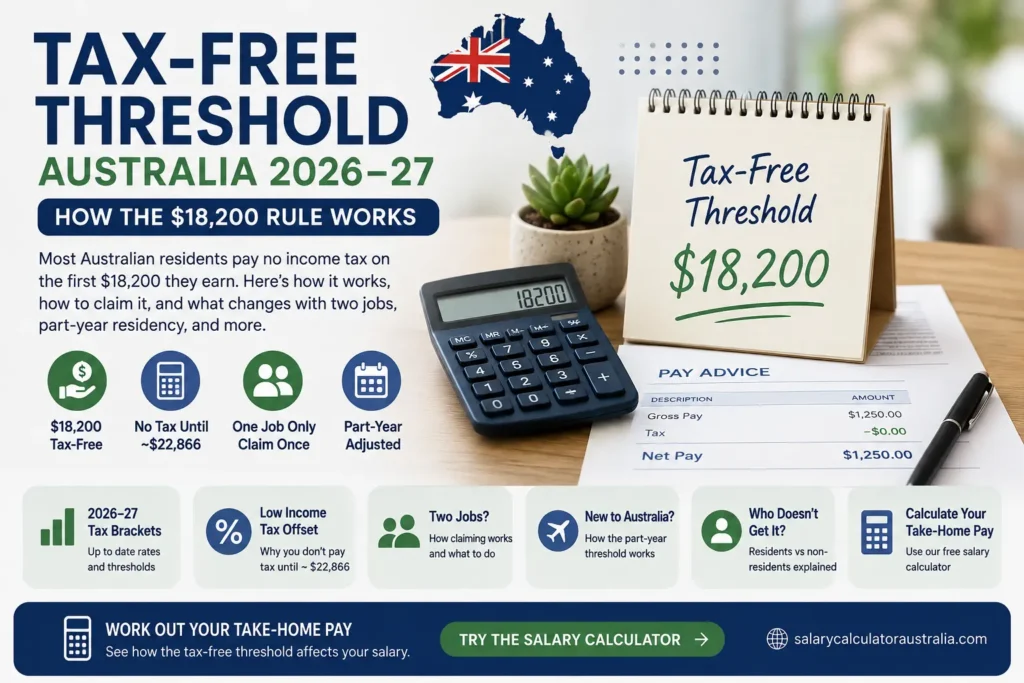
This guide covers what the threshold is worth per pay cycle, how to claim it correctly, what changes with two jobs, and how it’s adjusted for people who arrive in or leave Australia partway through the year.
Key Takeaways
- The tax-free threshold is $18,200 for the 2026–27 financial year, and has been unchanged since 2012–13.
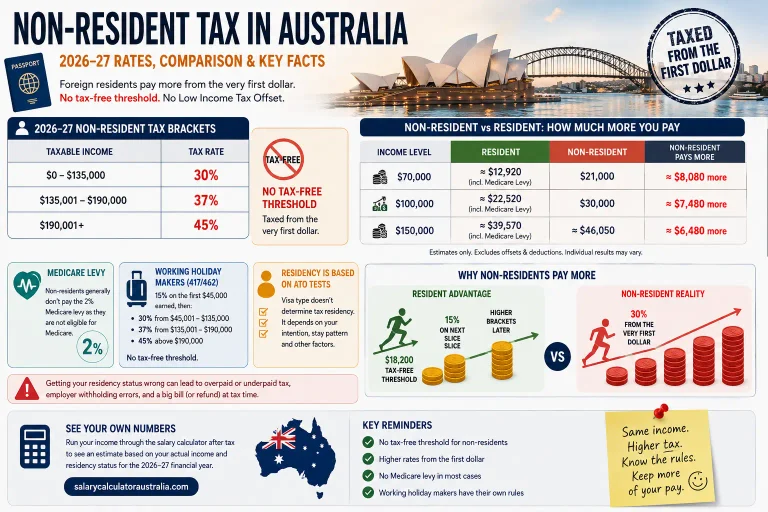
- It applies only to Australian residents for tax purposes — non-residents are taxed from their first dollar earned.
- You claim it once, from the payer who pays you the most.
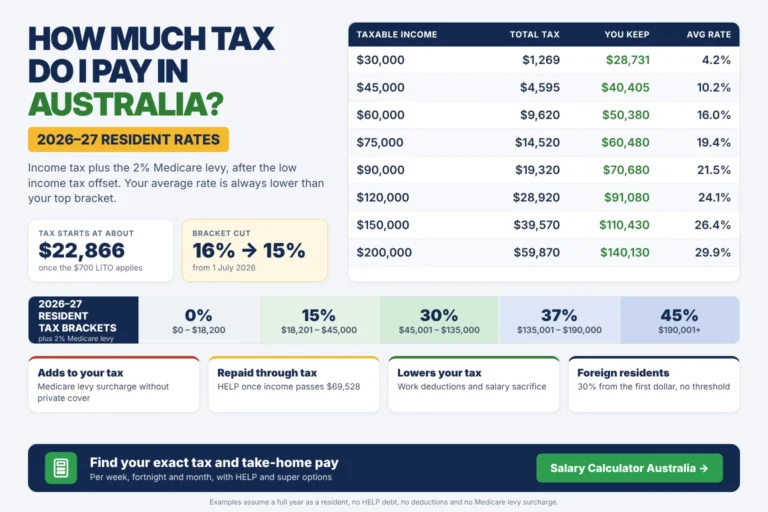
- Because of the Low Income Tax Offset, no tax is actually payable until income reaches roughly $22,866.
- Newcomers and people leaving Australia mid-year get a reduced, pro-rated threshold instead of the full $18,200.
What the Tax-Free Threshold Actually Means
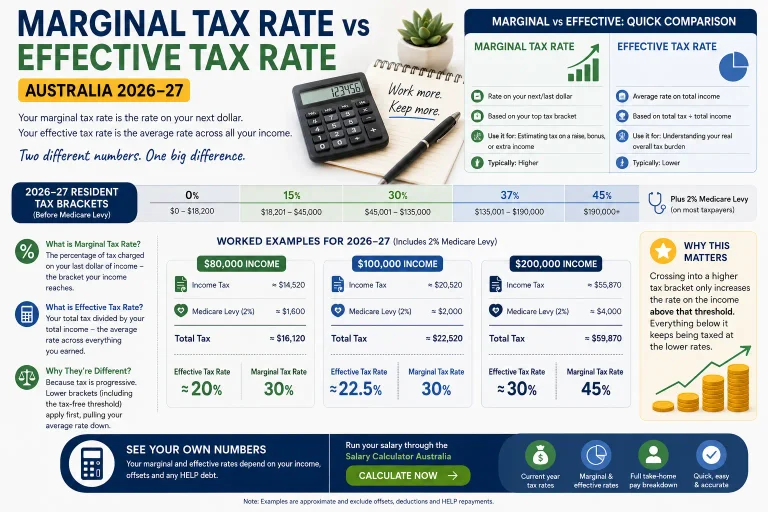
The tax-free threshold isn’t a discount or a rebate — it’s the slice of income, at the bottom of the scale, that simply isn’t taxed. Once income moves past it, only the portion above the threshold is taxed, not the whole amount. That’s the core of Australia’s progressive tax system: each dollar is taxed according to which bracket it falls into, not at a single flat rate applied to everything earned.Understanding marginal and effective tax rates can also help explain how those progressive brackets affect your overall tax burden.
Spread across the year, $18,200 works out to about $350 a week, $700 a fortnight or $1,517 a month. Employers don’t hand this over as a lump sum at the start of the year — they apply it gradually through each pay cycle, using the ATO’s withholding schedules to work out how much tax to hold back from each payment. If you are paid weekly, the weekly pay after tax calculator shows the threshold at work in a single week’s pay.
The 2026–27 Tax Brackets
For the 2026–27 financial year, Australian residents pay no tax on income up to $18,200, then 15% on the portion from $18,201 to $45,000, 30% up to $135,000, 37% up to $190,000, and 45% on anything above $190,000. These figures sit before the separate 2% Medicare levy, which most taxpayers also pay.
The 15% rate is new for this financial year — the second bracket cut from 16% to 15% from 1 July 2026, the first of two legislated rate cuts, while every bracket threshold stayed the same as the year before.
Why You Don’t Actually Pay Tax Until ~$22,866
Earning a dollar over $18,200 doesn’t mean tax starts landing in your pay slip straight away. The Low Income Tax Offset (LITO) — worth up to $700 — cancels out the tax owed on the next slice of income above the threshold. The practical effect is that no income tax is actually payable until income reaches around $22,866, even though the official threshold on paper is $18,200. This is a common point of confusion — the $18,200 figure and the point where tax genuinely starts aren’t quite the same number.
How to Claim the Tax-Free Threshold
You claim the threshold through the Tax File Number (TFN) declaration you give a new employer, by answering the relevant question about whether you want to claim the tax-free threshold from that payer.
The rule that trips people up is: claim it from one payer only — normally whichever job pays you the most. If you claim it from more than one employer at the same time, not enough tax gets withheld across your combined income, which usually means a tax bill rather than a refund when you lodge your return.
What Happens With Two Jobs
Each employer withholds tax independently, based only on what they pay you — they generally assume it’s your only job unless you tell them otherwise. If you claim the threshold at your main job and don’t claim it at the second, your second employer withholds tax from the first dollar you earn there, at a flat rate rather than the progressive scale.
This feels like paying more tax on the second job, but it isn’t a penalty — it’s simply withholding calculated correctly across two income sources instead of one. Your actual tax liability is worked out once, at tax time, on your combined income for the year. If you realise your withholding is set up incorrectly partway through the year, you can lodge a new TFN declaration with either employer to adjust it before it snowballs into a larger bill.
Newcomers, Leavers, and the Part-Year Threshold
The full $18,200 threshold assumes you were an Australian resident for tax purposes for the entire financial year. If you became a resident partway through the year — for example, moving to Australia to start your first job here — or you left partway through with the intention of living overseas, you don’t get the full amount.
Instead, you get a reduced, pro-rated threshold made up of two parts: a fixed component, plus an additional $4,736 apportioned for the number of months you were in Australia during the income year, including the month you arrived. Based on this, the minimum part-year threshold is at least $13,464, rising toward the full $18,200 the longer you were a resident during the year. The ATO calculates this figure for you automatically based on your tax return.
Who Doesn’t Get the Threshold
Residency for tax purposes — not visa type — determines eligibility. Non-residents don’t receive the tax-free threshold at all and are taxed from the first dollar of Australian-sourced income, generally at higher flat rates than residents pay on the same income band. Working holiday makers sit under their own separate schedule rather than the standard resident brackets or the non-resident rates. If you’re unsure which category applies to you, the ATO’s residency tests — not the visa you hold — settle the question.
How This Affects Your Take-Home Pay
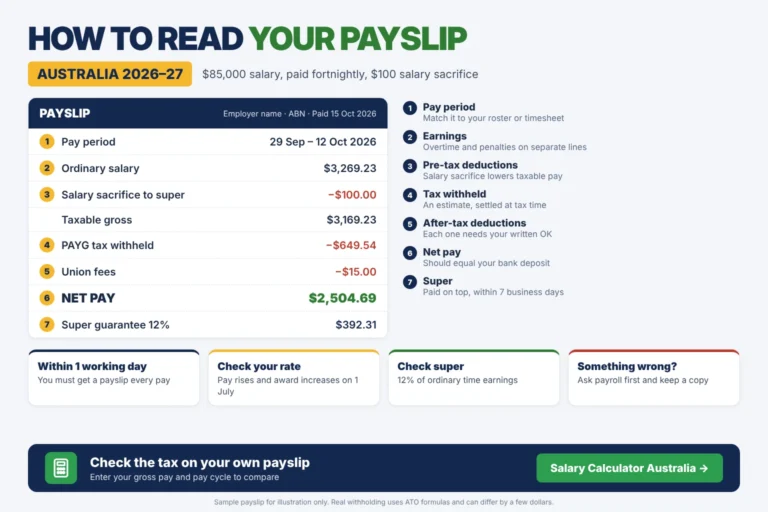
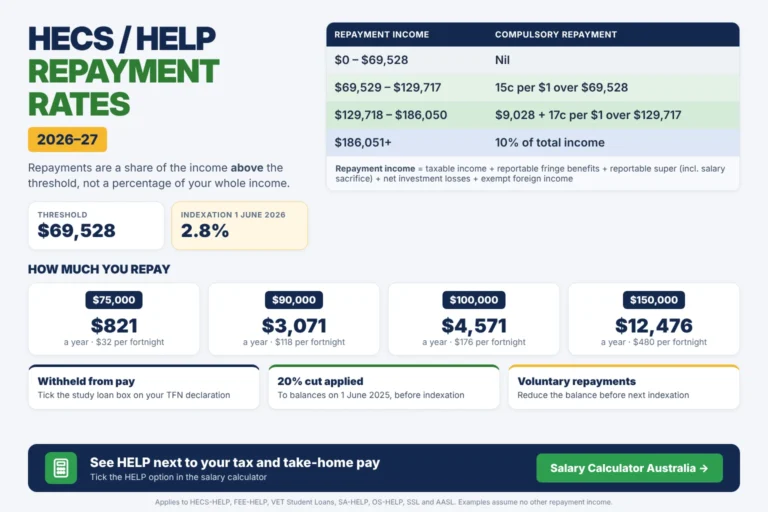
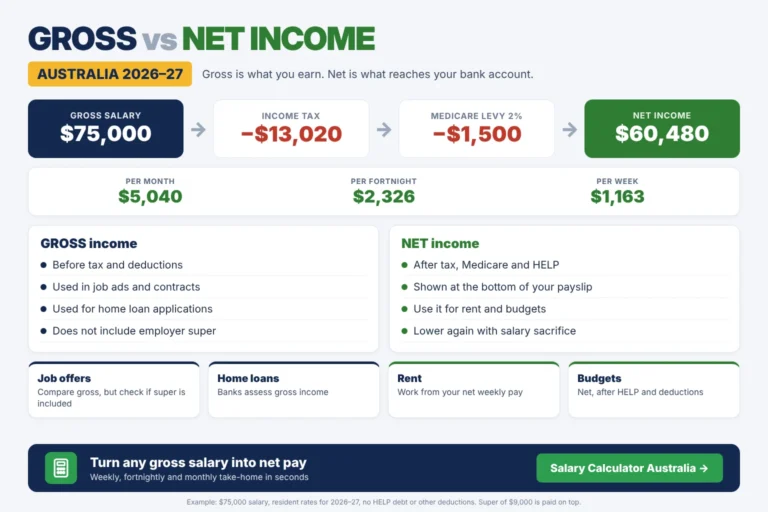
The tax-free threshold is one of several factors that determine what actually lands in your account each pay cycle, alongside your tax bracket, the Medicare levy, and any HELP repayments. To see exactly how the threshold plays out against your own salary, pay frequency, and financial year, run the numbers through the salary calculator — it applies the correct threshold and current-year brackets automatically.
FAQ Section
What is the tax-free threshold in Australia?
It’s the amount of income — $18,200 for 2026–27 — that Australian residents can earn in a financial year before income tax applies. Only income above that amount is taxed.
Has the tax-free threshold changed recently?
No. The $18,200 figure has stayed the same since the 2012–13 financial year, even though the tax brackets above it have changed.
Do I pay tax as soon as I earn over $18,200?
Not in practice. The Low Income Tax Offset means no tax is actually payable until income reaches roughly $22,866, though $18,200 remains the official threshold figure.
Should I claim the tax-free threshold on my second job?
Generally no. Claim it only from the employer who pays you the most. Claiming it at more than one job usually results in too little tax being withheld overall.
Do non-residents get the tax-free threshold?
No. Non-residents for tax purposes are taxed from the first dollar of Australian-sourced income and don’t receive any tax-free threshold.
What if I moved to Australia partway through the financial year?
You receive a reduced, pro-rated threshold rather than the full $18,200, calculated based on the number of months you were an Australian resident during that year.
Does the tax-free threshold apply to working holiday makers?
No. Working holiday makers are taxed under a separate schedule, not the standard resident tax-free threshold and brackets.