How Much Tax Do I Pay in Australia? 2026–27 Rates and Examples
Most Australian workers pay between 10% and 30% of their income in tax, even though the brackets go up to 45%. How much you pay depends on your taxable income, whether you are a resident, and a few extras such as the Medicare levy and study loans. This guide shows the 2026–27 rates, what someone on a typical income actually pays, and the main things that make your own figure higher or lower.
Key takeaways
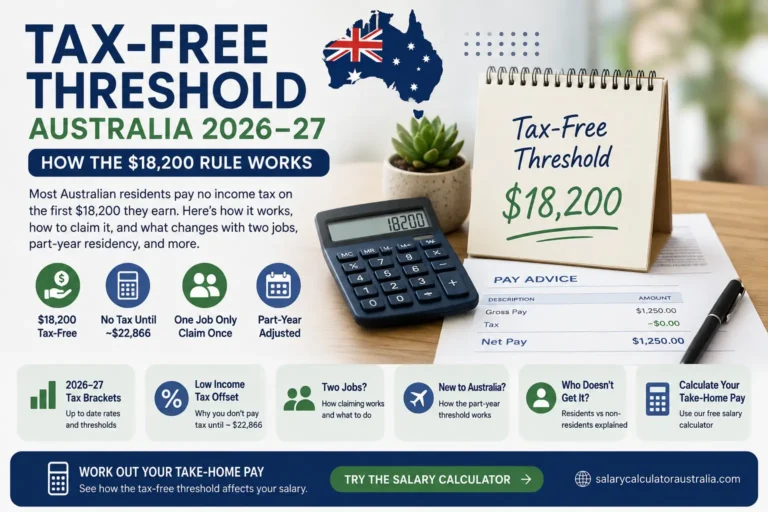
- Residents pay no income tax on the first $18,200, and effectively none until about $22,866 once the low income tax offset is applied.
- The rate on income between $18,201 and $45,000 fell to 15% from 1 July 2026.
- A worker on $75,000 pays about $14,520 a year in tax and Medicare levy, which is around 19% of their salary.
- Your top bracket is not the rate you pay on everything. Your average rate is always lower.
Australian income tax rates for 2026–27
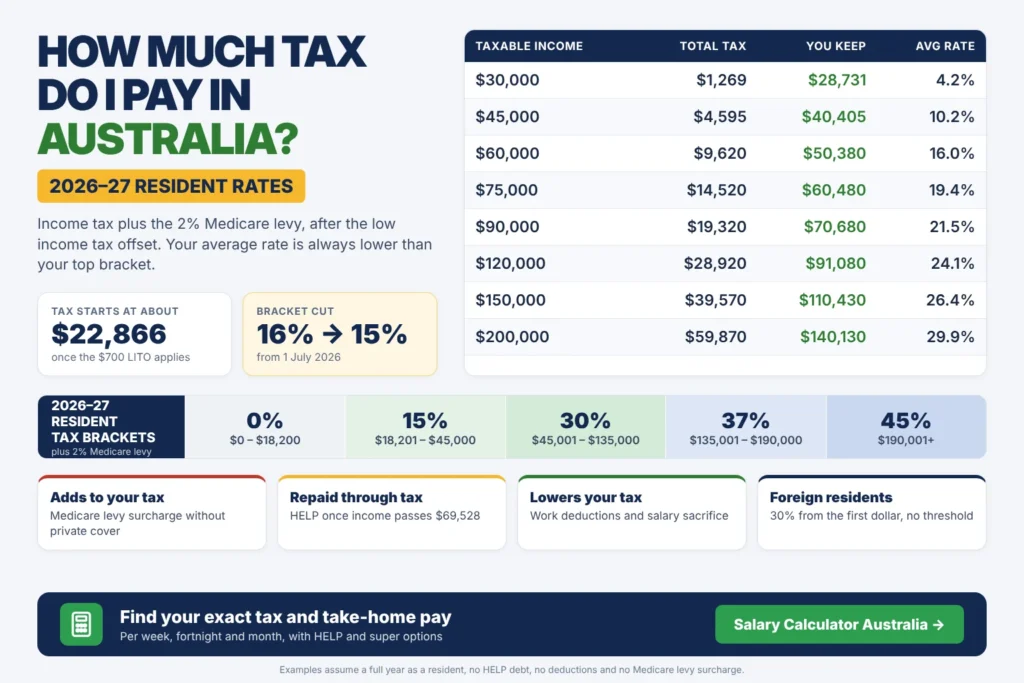
These rates apply to Australian residents from 1 July 2026 to 30 June 2027.
| Taxable income | Tax on this income |
|---|---|
| $0 – $18,200 | Nil |
| $18,201 – $45,000 | 15c for each $1 over $18,200 |
| $45,001 – $135,000 | $4,020 plus 30c for each $1 over $45,000 |
| $135,001 – $190,000 | $31,020 plus 37c for each $1 over $135,000 |
| $190,001 and over | $51,370 plus 45c for each $1 over $190,000 |
The 2% Medicare levy is added on top of these rates.
How much tax you pay at common incomes
The table assumes a full year as a resident, no study loan, private hospital cover (so no Medicare levy surcharge) and no deductions.
| Taxable income | Income tax | Medicare levy | Total tax | Left after tax | Average rate |
|---|---|---|---|---|---|
| $30,000 | $1,070 | $199 | $1,269 | $28,731 | 4.2% |
| $45,000 | $3,695 | $900 | $4,595 | $40,405 | 10.2% |
| $60,000 | $8,420 | $1,200 | $9,620 | $50,380 | 16.0% |
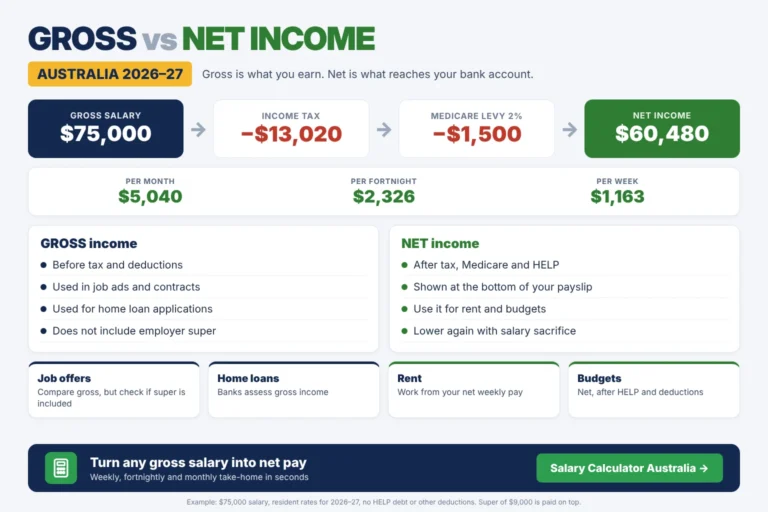
| $75,000 | $13,020 | $1,500 | $14,520 | $60,480 | 19.4% |
| $90,000 | $17,520 | $1,800 | $19,320 | $70,680 | 21.5% |
| $100,000 | $20,520 | $2,000 | $22,520 | $77,480 | 22.5% |
| $120,000 | $26,520 | $2,400 | $28,920 | $91,080 | 24.1% |
| $150,000 | $36,570 | $3,000 | $39,570 | $110,430 | 26.4% |
| $200,000 | $55,870 | $4,000 | $59,870 | $140,130 | 29.9% |
For any other figure, enter your salary in our salary calculator and it will show the same breakdown per week, fortnight and month.
Working it out yourself: $85,000 step by step
- Tax on the first $45,000: $4,020, taken straight from the table above.
- Tax on the rest: $85,000 minus $45,000 leaves $40,000, taxed at 30%, which is $12,000.
- Income tax: $4,020 plus $12,000 equals $16,020. The low income tax offset has fully phased out at this income.
- Medicare levy: 2% of $85,000 is $1,700.
- Total: $17,720 for the year, leaving $67,280.
If the same person had a HELP debt, a further $2,321 would be added, because their income is above the $69,528 repayment threshold.
Why your average rate is lower than your bracket
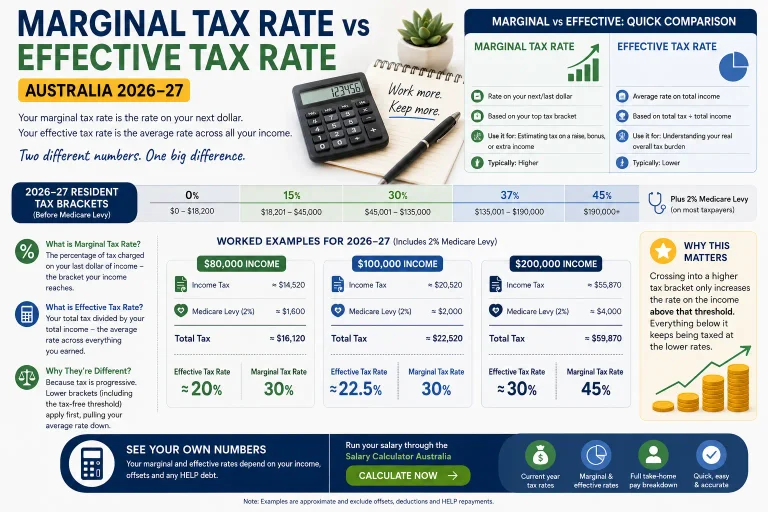
Someone on $85,000 is in the 30% bracket, but they pay about 21% of their income in total. That is because each slice of income is taxed at its own rate, starting at 0%. The rate on your next dollar is your marginal rate; the share of your whole income that goes in tax is your average, or effective, rate. Our guide on the two kinds of tax rate explains why the difference matters when you think about overtime or a pay rise.
What can increase your tax
Medicare levy surcharge
If you do not have an appropriate level of private hospital cover and your income for surcharge purposes is over $105,000 as a single, you pay an extra 1% to 1.5% on top of the Medicare levy. The thresholds are higher for families.
Study and training loans
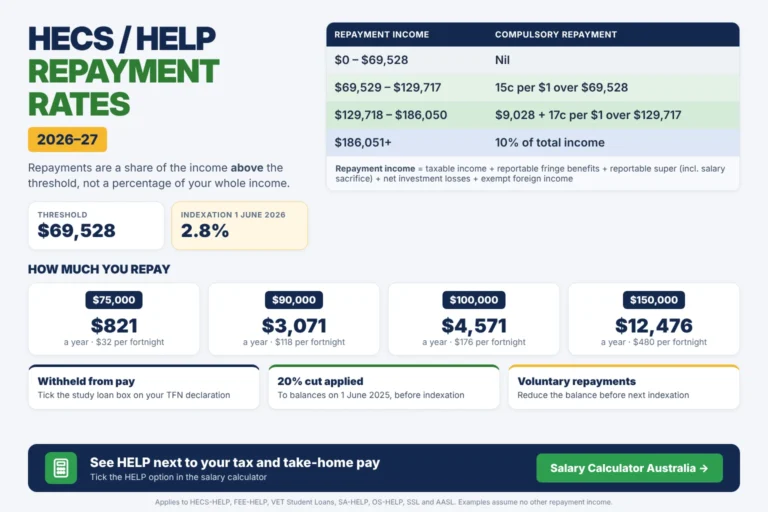
HELP, VET Student Loan and similar debts are repaid through the tax system once your repayment income passes $69,528. It is not a tax, but it comes out of your pay the same way. See the 2026–27 HELP repayment rates for how much is added.
Income with no tax taken out
Interest, rental income, side work and capital gains all add to your taxable income. If nothing was withheld during the year, the tax on that income shows up as a bill when you lodge.
What can reduce your tax
- Work-related deductions such as tools, uniforms, union fees and some travel, as long as you have records.
- Salary sacrifice into super, which is taxed at 15% instead of your marginal rate.
- Personal super contributions you claim as a deduction, within the $32,500 concessional cap.
- Tax offsets such as the low income tax offset, which is applied automatically when you lodge.
- Salary packaging, if you work for a charity, hospital or ambulance service.
Residents and foreign residents
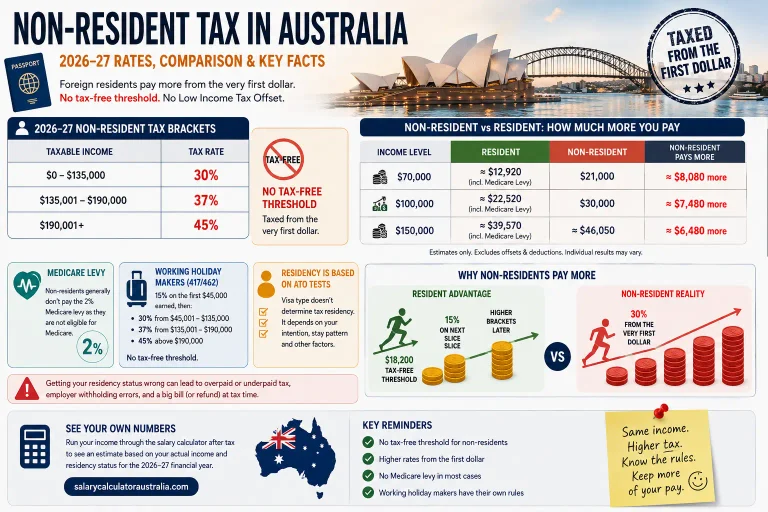
Everything above is for Australian residents. Foreign residents pay 30% from their first dollar up to $135,000 and get no tax-free threshold, while working holiday makers pay 15% on their first $45,000. Read how non-residents are taxed if you are not sure which group you belong to.
Tax taken from each pay vs tax at the end of the year
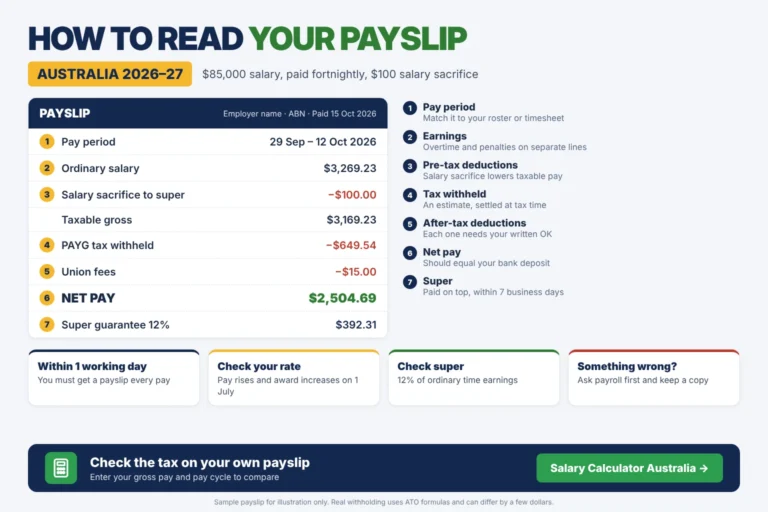
Your employer does not wait until June. They withhold an estimate of your tax from every pay and send it to the ATO, and your tax return then settles the difference. If you want to check whether the right amount is coming out of each pay, use the PAYG withholding calculator with the gross figure from your payslip.
Frequently asked questions
How much tax do I pay on $50,000 in Australia?
In 2026–27 a resident on $50,000 pays about $5,270 in income tax after the low income tax offset, plus $1,000 Medicare levy, for a total of $6,270. That leaves roughly $43,730 for the year.
At what income do I start paying tax?
The tax-free threshold is $18,200, but the $700 low income tax offset wipes out the tax on the next few thousand dollars. In 2026–27 a resident does not pay any income tax until taxable income passes about $22,866.
Do I pay 30% tax on all my income?
No. Australia uses marginal rates, so 30% applies only to the part of your income between $45,001 and $135,000. Earlier dollars are taxed at 0% and 15%, which is why your overall rate is much lower than your top bracket.
Does a pay rise push all my income into a higher bracket?
No. Only the dollars above the bracket limit are taxed at the higher rate. A pay rise always leaves you with more take-home pay than before, even if it crosses a bracket.
Is the Medicare levy included in the tax rates?
No. The 2% Medicare levy is charged on top of the income tax rates. People on low incomes pay a reduced levy or none at all.
Do foreign residents pay the same tax?
No. Foreign residents for tax purposes pay 30% from the first dollar up to $135,000, with no tax-free threshold and no low income tax offset, but they do not pay the Medicare levy.