HECS/HELP Repayment Rates 2026–27: Thresholds, Examples and Indexation
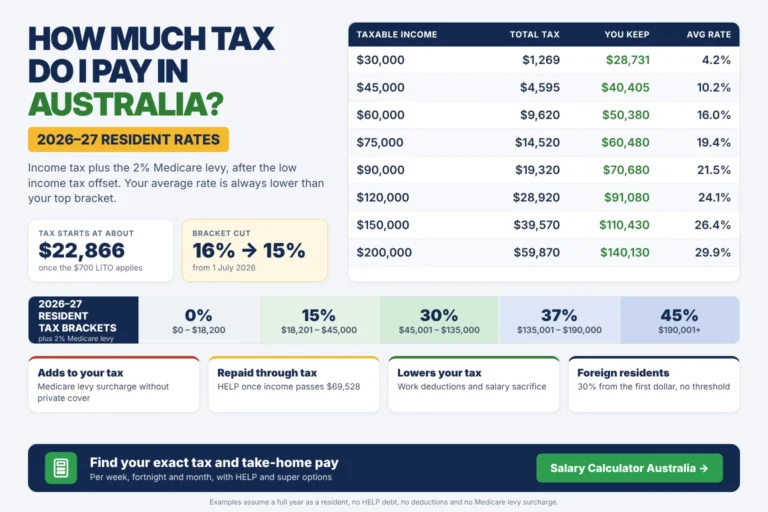
HELP repayments are worked out on a marginal system from 2025–26 onwards. Instead of a percentage of your whole income, you repay a share of the income above a threshold, so the amount starts small and rises gradually. For 2026–27, compulsory repayments begin once your repayment income passes $69,528. The same rules cover HECS-HELP, FEE-HELP, VET Student Loans, SA-HELP, OS-HELP, Student Start-up Loans and Australian Apprenticeship Support Loans.
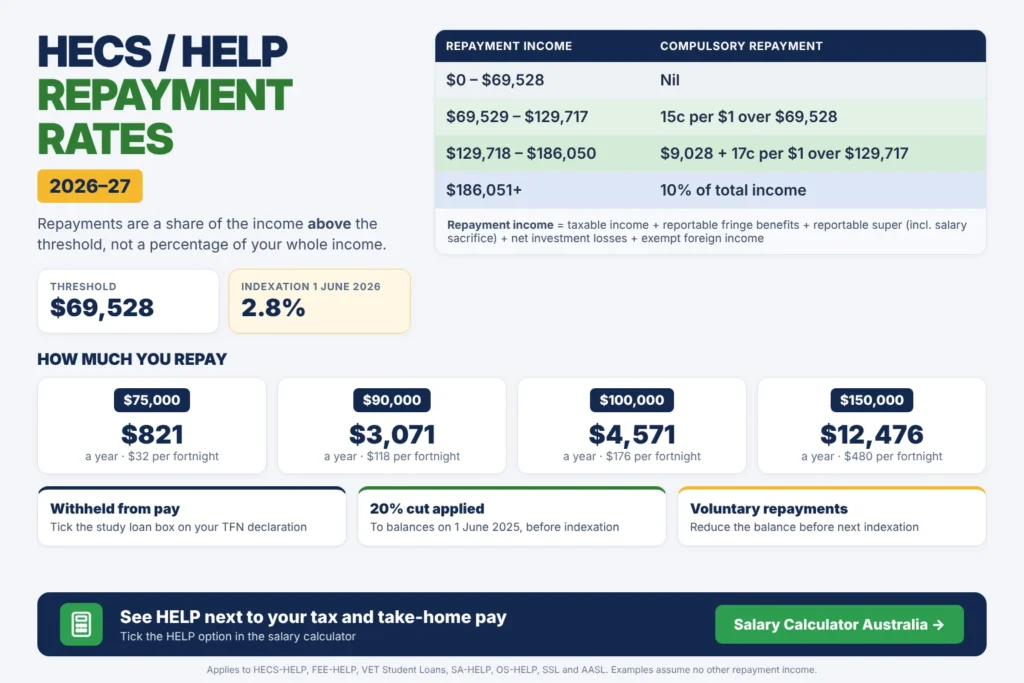
HELP repayment rates for 2026–27
| Repayment income | Compulsory repayment |
|---|---|
| $0 – $69,528 | Nil |
| $69,529 – $129,717 | 15c for each $1 over $69,528 |
| $129,718 – $186,050 | $9,028 plus 17c for each $1 over $129,717 |
| $186,051 and over | 10% of total repayment income |
The thresholds are indexed every year, so check them again each July.
How much you repay at different incomes
| Repayment income | Repayment per year | Per fortnight | Share of income |
|---|---|---|---|
| $65,000 | $0 | $0 | 0.0% |
| $70,000 | $71 | $3 | 0.1% |
| $75,000 | $821 | $32 | 1.1% |
| $80,000 | $1,571 | $60 | 2.0% |
| $90,000 | $3,071 | $118 | 3.4% |
| $100,000 | $4,571 | $176 | 4.6% |
| $120,000 | $7,571 | $291 | 6.3% |
| $140,000 | $10,776 | $414 | 7.7% |
| $160,000 | $14,176 | $545 | 8.9% |
| $190,000 | $19,000 | $731 | 10.0% |
To see the repayment next to your income tax and Medicare levy, tick the HELP option in our take-home pay calculator.
A worked example on $90,000
Mia earns $90,000 and has no other income.
- Her repayment income is above the $69,528 threshold by $20,472.
- She repays 15% of that amount: $3,071 for the year.
- Her employer withholds about $118 a fortnight from her pay for HELP, on top of her tax.
Under the old system, which charged a percentage of total income, she would have repaid noticeably more at this salary. Workers just above the threshold gained the most from the change.
What counts as repayment income
Repayment income is not just your taxable income. It is your taxable income plus:
- reportable fringe benefits, for example from salary packaging
- reportable super contributions, including salary sacrifice
- total net investment losses, such as negative gearing
- exempt foreign employment income
This means you cannot reduce HELP repayments by sacrificing salary into super. The money is added back. The same applies to packaged living expenses, which is why our packaging calculator includes HELP when it works out your saving.
How HELP is taken from your pay
If you tell your employer on your TFN declaration that you have a study loan, they add a HELP amount to the tax withheld from each pay. The amount is based on your pay for that period, treated as if you earned it all year. When you lodge your return, the ATO works out the real repayment for the year and credits what was withheld. The payslip tax checker has a study loan option so you can see the combined amount per pay.
Indexation and the 20% reduction
Indexation on 1 June 2026
HELP debts do not charge interest, but the balance is indexed once a year on 1 June. The rate is the lower of the consumer price index and the wage price index. On 1 June 2026 the rate was 2.8%, applied to debt that had been owed for more than 11 months.
The one-off 20% cut
A 20% reduction was applied to study loan balances as they stood on 1 June 2025, before that year’s indexation. The ATO applied it automatically, and anyone who had already paid off that debt in full received a refund of the reduced amount.
Should you make voluntary repayments?
Voluntary repayments go straight off your balance and reduce the amount that gets indexed next June. They make most sense when indexation is high and you have no higher-interest debt such as a credit card. With indexation at 2.8% in 2026, many people put spare cash into an offset account, super or other debts first. Voluntary repayments do not reduce your compulsory repayment for the year.
Frequently asked questions
What is the HELP repayment threshold for 2026–27?
Compulsory repayments start when your repayment income is more than $69,528. Below that, nothing is repaid through the tax system.
How much HELP do I repay on $100,000?
About $4,571 a year in 2026–27. Under the marginal system, 15 cents is repaid for each dollar of repayment income between $69,528 and $129,717.
Was HELP debt indexed in 2026?
Yes. Indexation of 2.8% was applied on 1 June 2026 to debt that had been owed for more than 11 months. Voluntary payments made before that date were taken off the balance first.
Does the 20% HELP cut apply to me?
The one-off 20% reduction applied to HELP and other study loan balances as they stood on 1 June 2025, before indexation that year. If you had a debt then, the ATO has already applied it. New debts taken on after that date were not reduced.
Can I ask my employer to stop taking HELP out of my pay?
Not if your income is above the threshold. If you expect your income for the year to stay below $69,528, for example because you work part time, you can ask the ATO for a variation, but any shortfall is still raised when you lodge.
Do I repay HELP if I live overseas?
Yes. If you move overseas you must update your contact details with the ATO and report your worldwide income each year. Repayments apply at the same thresholds as in Australia.