Second Job Tax in Australia: Why You Pay More (and Can Still Owe)
Written by: Salary Calculator Australia Editorial Team · Fact-checked against: ATO 2026–27 tax rates, Medicare levy and HELP thresholds · Last reviewed: October 2026
If you have a second job, your employer usually takes more tax from each pay because you can only claim the tax-free threshold with one employer. But here is the surprise most people don’t expect: the extra tax taken is often not enough, and many people with two jobs end up with a tax bill at tax time, not a refund.
This guide explains why both things happen, shows a real example, and gives you simple steps so tax time doesn’t catch you out.
Why your second job takes more tax
Every employer withholds tax as if your pay from them is your only income. The tax-free threshold, which is $18,200 a year, lets the first part of your income go untaxed. You can only claim it once, so your main employer applies it and your second employer doesn’t.
That means your second job is taxed from the very first dollar. On a small second job, this can feel like a lot. A $300 weekly shift that had no tax with one job suddenly loses about $50 a week.
Why you can still end up owing tax
Your second employer only knows what they pay you. They withhold tax using the lower tax brackets, as if their wage were your whole income. In reality, that second income sits on top of your main salary, so it is taxed at your higher marginal rate.
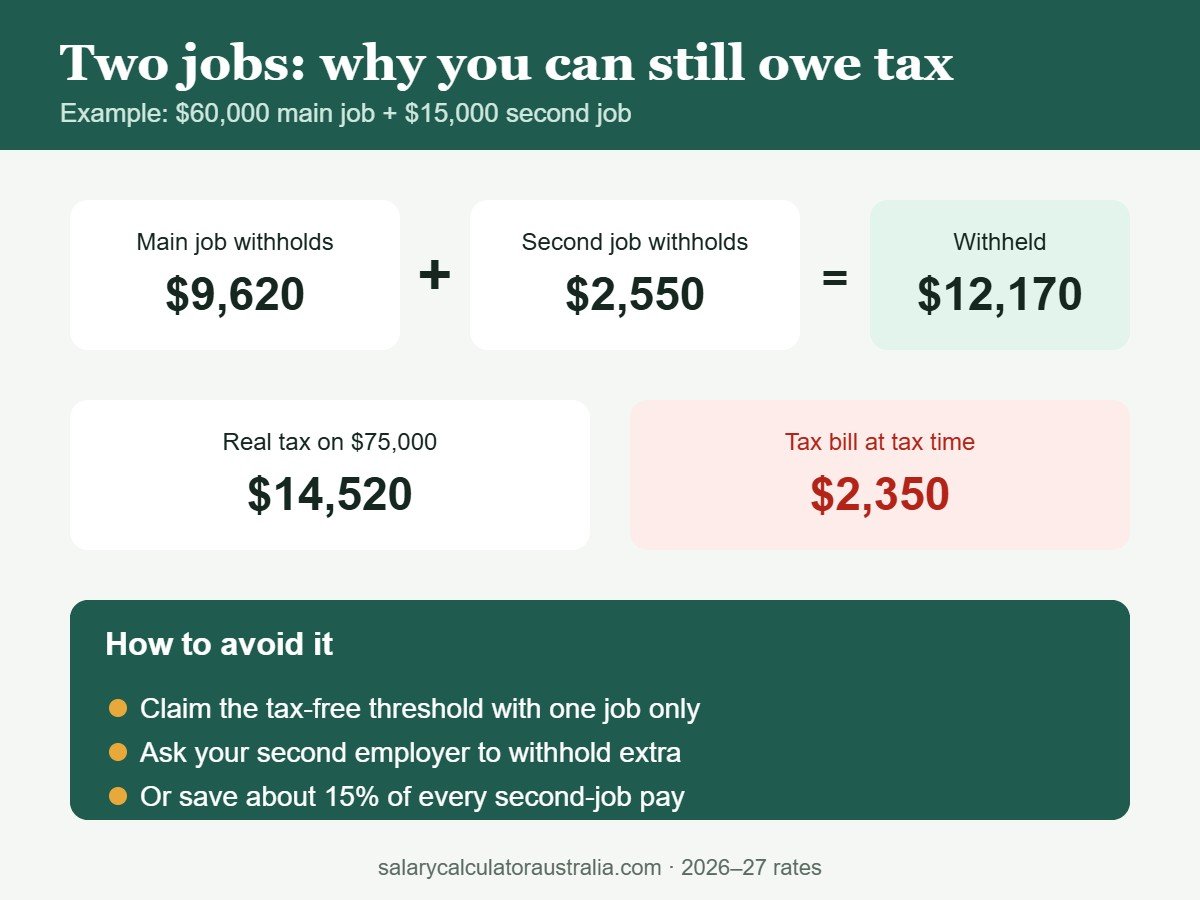
Example: $60,000 main job plus $15,000 second job
| Amount | |
|---|---|
| Main job salary (tax-free threshold claimed) | $60,000 |
| Tax withheld by main job | about $9,620 |
| Second job income (no tax-free threshold) | $15,000 |
| Tax withheld by second job | about $2,550 |
| Total tax withheld during the year | about $12,170 |
| Actual tax on $75,000 income (2026–27) | about $14,520 |
| Likely tax bill at tax time | about $2,350 |
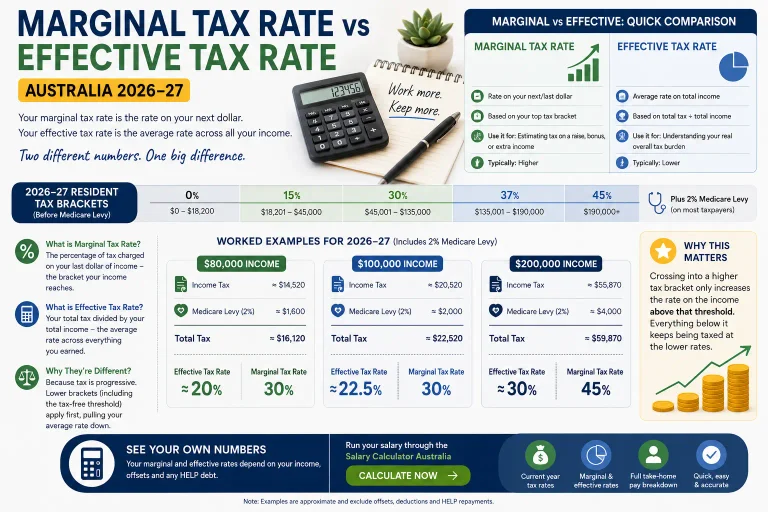
Even though the second job “felt” heavily taxed, it was under-taxed by about $2,350. Each extra dollar you earn above $45,000 is taxed at 30% plus 2% Medicare levy, but the second employer only withheld at about 17%. Our guide to marginal and effective tax rates explains why the last dollars you earn are taxed more heavily.
The biggest mistake: claiming the threshold twice
If you tick “yes” to the tax-free threshold on both jobs, neither employer taxes your first $18,200. Your pay looks great all year, and then you get a large bill. In the example above, the bill would be about $4,900 instead of $2,350.
Only claim the threshold with the job that pays you the most, usually your main job. If you have already ticked it twice, fill in a new Tax file number declaration for your second employer and tick “no”.
How to avoid a tax bill with two jobs
- Claim the tax-free threshold once, with your highest-paying job.
- Ask your second employer to withhold more. You can agree in writing for them to take an extra amount from each pay. It is like saving for your tax bill automatically.
- Put money aside yourself. If you prefer, move 15% of every second-job pay into a separate savings account.
- Tick HELP on both jobs if you have a study loan, so repayments are withheld from both incomes. See our HELP repayment thresholds for 2026–27.
- Check your payslips for both jobs to make sure the tax-free threshold setting is correct.
When a second job gives you a refund instead
You may still get a refund if your total income stays low, if you only worked part of the year, or if you have work-related deductions. For example, if your main job pays $20,000 and your second job pays $10,000, your total of $30,000 is taxed lightly, so the second job’s withholding is often more than you owe.
| Your total income from all jobs | What usually happens |
|---|---|
| Under about $45,000 | Second job often over-taxed, so a refund is likely |
| $45,000 to $135,000 | Second job often under-taxed, so a bill is likely |
| Over $135,000 | Bill very likely unless extra tax is withheld |
Does a second job push me into a higher tax bracket?
Only the extra dollars are taxed at the higher rate, not your whole income. Australia’s brackets work in steps. If your second job takes you from $40,000 to $55,000 total, only the part above $45,000 is taxed at 30%. You never take home less money by earning more. To see how much of each pay you keep, use our weekly pay after tax tool or the fortnightly version.
Side hustles and ABN work
If your second income comes from freelancing or a side business with an ABN, no tax is withheld at all. You will need to set aside money yourself, usually around 30% of your profit if you already have a full-time job. Our PAYG withholding calculator shows how much tax your main job already covers.
Common questions
Why is my second job taxed so much?
Because you can only claim the tax-free threshold with one employer, so your second job is taxed from the first dollar.
Do you pay more tax with two jobs?
You pay the same total tax as one job with the same total income. Two jobs only change how much is withheld during the year, which can lead to a refund or a bill.
Should I claim the tax-free threshold on both jobs?
No. Claim it only with your highest-paying job. Claiming it twice usually leads to a large tax bill.
Will I get a tax bill with two jobs?
Often yes if your total income is above about $45,000, because the second employer withholds at a lower rate than your real marginal rate.
How can I avoid owing tax with two jobs?
Ask your second employer to withhold extra tax from each pay, or save around 15% of each second-job pay for tax time.