Salary Plus Super vs Package: What Your Job Offer Really Pays
Written by: Salary Calculator Australia Editorial Team · Fact-checked against: ATO 2026–27 tax rates, Medicare levy and HELP thresholds · Last reviewed: October 2026
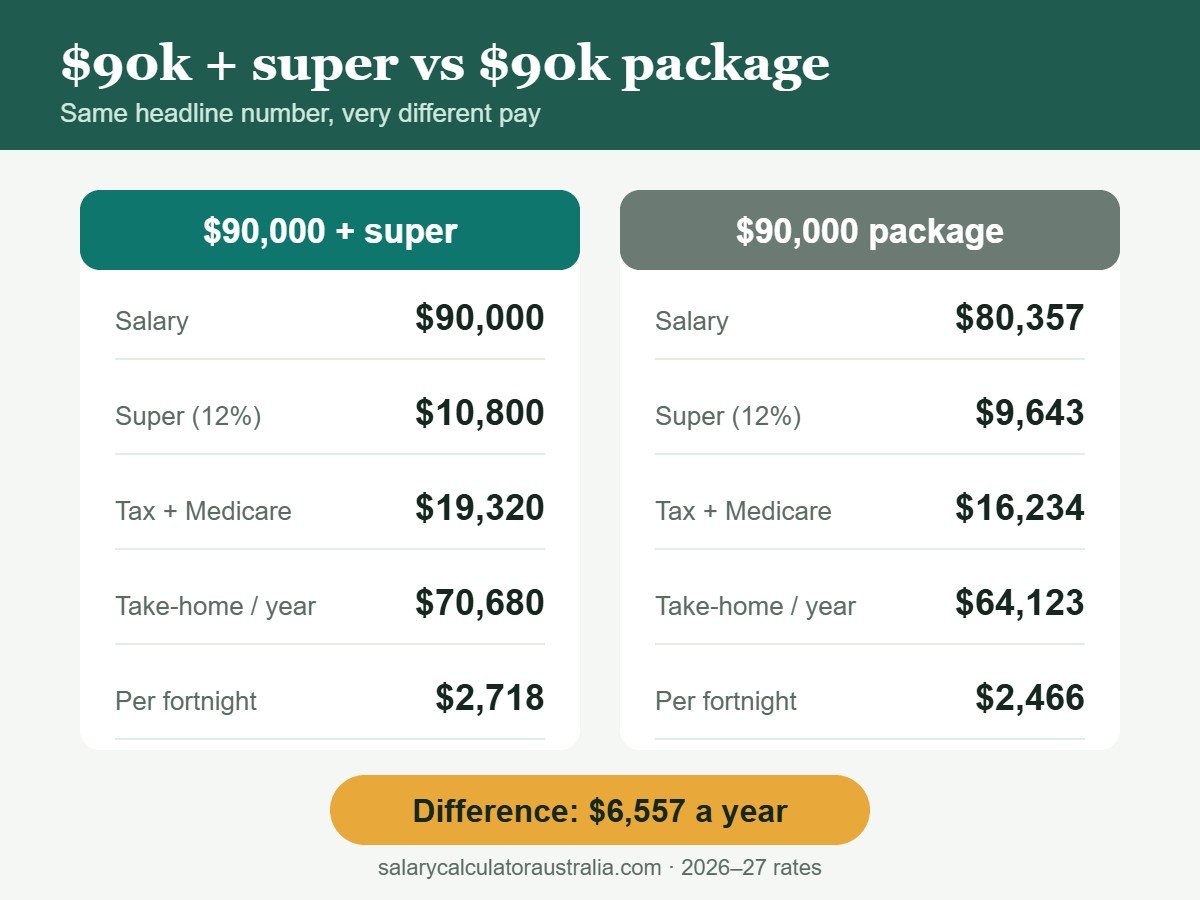
“$90,000 plus super” and “$90,000 package” sound almost the same, but they are not. With “plus super”, your employer pays 12% super on top, so your salary is $90,000. With a “package” that includes super, the $90,000 already contains your super, so your actual salary is only about $80,357. That difference costs you around $6,550 a year in take-home pay, or about $250 every fortnight.
This guide shows you how to read any Australian job offer, spot which kind it is, and compare two offers fairly before you sign.
The three ways salary is advertised in Australia
| What the ad says | What it means | Your actual salary on “$90,000” |
|---|---|---|
| $90,000 + super | Salary is $90,000. Super (12%) is paid on top | $90,000 |
| $90,000 base | Same as above. Base means salary before super | $90,000 |
| $90,000 package, total remuneration or “inclusive of super” | The $90,000 includes your super | About $80,357 |
Some ads also say TRP (total remuneration package) or TFR (total fixed remuneration). Both usually mean super is included. Government and university jobs often add other items, like a car or salary packaging, into the package figure too.
How to work out the real salary inside a package
Divide the package by 1.12. That removes the 12% super your employer must pay in 2026–27.
- $80,000 package ÷ 1.12 = $71,429 salary
- $90,000 package ÷ 1.12 = $80,357 salary
- $100,000 package ÷ 1.12 = $89,286 salary
- $120,000 package ÷ 1.12 = $107,143 salary
The rule works for most packages. If the package also includes a car, phone or other benefits, ask the employer for the cash salary figure in writing, because those extras reduce your take-home cash even further.
What the difference means for your pay
| $90,000 + super | $90,000 package | |
|---|---|---|
| Salary | $90,000 | $80,357 |
| Super paid by employer | $10,800 | $9,643 |
| Tax and Medicare (2026–27) | $19,320 | $16,234 |
| Take-home per year | $70,680 | $64,123 |
| Take-home per fortnight | $2,718 | $2,466 |
| Total cost to the employer | $100,800 | $90,000 |
The “plus super” offer gives you about $6,557 more each year in your bank account, and about $1,157 more in super. You can put any salary into our take-home pay calculator to see the same breakdown for your own numbers.
Why employers use packages
A package figure looks bigger, and it shows the employer’s total cost in one number. That is not dishonest on its own, but it makes offers hard to compare. A recruiter quoting “$90k package” against another company’s “$85k plus super” might make the first one look better when it is actually worse.
| Offer | Real salary | Take-home per year |
|---|---|---|
| Company A: $90,000 package | $80,357 | $64,123 |
| Company B: $85,000 + super | $85,000 | $67,280 |
Company B pays about $3,150 more a year after tax, even though its headline number is $5,000 lower.
Questions to ask before you accept an offer
- Is super included in this figure or paid on top? Ask for the answer in writing.
- What is the base salary on the contract? That is the number your pay is calculated from.
- Are there allowances, bonuses or overtime? Super is paid on your ordinary earnings, but usually not on overtime.
- Is salary packaging or salary sacrifice offered? Hospitals, charities and some government jobs let you pay certain costs before tax, which can lift your take-home pay. Our salary packaging guide and calculator shows how much it can save.
- When are you paid? Weekly, fortnightly and monthly pay change how you budget, not how much you earn.
What changed for super in 2026
From 1 July 2026, under the new Payday Super rules, employers must pay your super at the same time as your wages, rather than every quarter. The super rate stays at 12%. This makes it easier to check that super has actually been paid, because it should show up in your fund within days of each payday.
It is worth comparing the super amount on each payslip line by line with your fund’s app every few months. Unpaid super is one of the most common pay problems in Australia.
Comparing a contract or casual offer
If one offer is an annual salary and the other is an hourly rate, convert both to the same unit first. Remember that casual rates include a 25% loading instead of paid leave, so a casual hourly rate needs to be higher to match a permanent salary. You can convert an annual figure into an hourly rate with our salary to hourly converter.
Common questions
What does $90k plus super mean?
It means your salary is $90,000 and your employer pays 12% super, $10,800, on top into your super fund.
What does a $90k package mean?
A package usually includes super, so a $90,000 package means about $80,357 salary plus $9,643 super.
How do I calculate salary from a package?
Divide the package by 1.12 to remove the 12% super. For example, $100,000 ÷ 1.12 = $89,286 salary.
Which is better, plus super or package?
For the same headline number, plus super is always better because your salary is higher and super is paid on top.
Is super paid on overtime?
Usually no. Super is paid on ordinary time earnings, which normally excludes overtime.