Average Salary in Australia 2026: What People Really Earn
Written by: Salary Calculator Australia Editorial Team · Fact-checked against: ABS Average Weekly Earnings (May 2026), ABS Employee Earnings and ATO 2026–27 tax rates · Last reviewed: October 2026
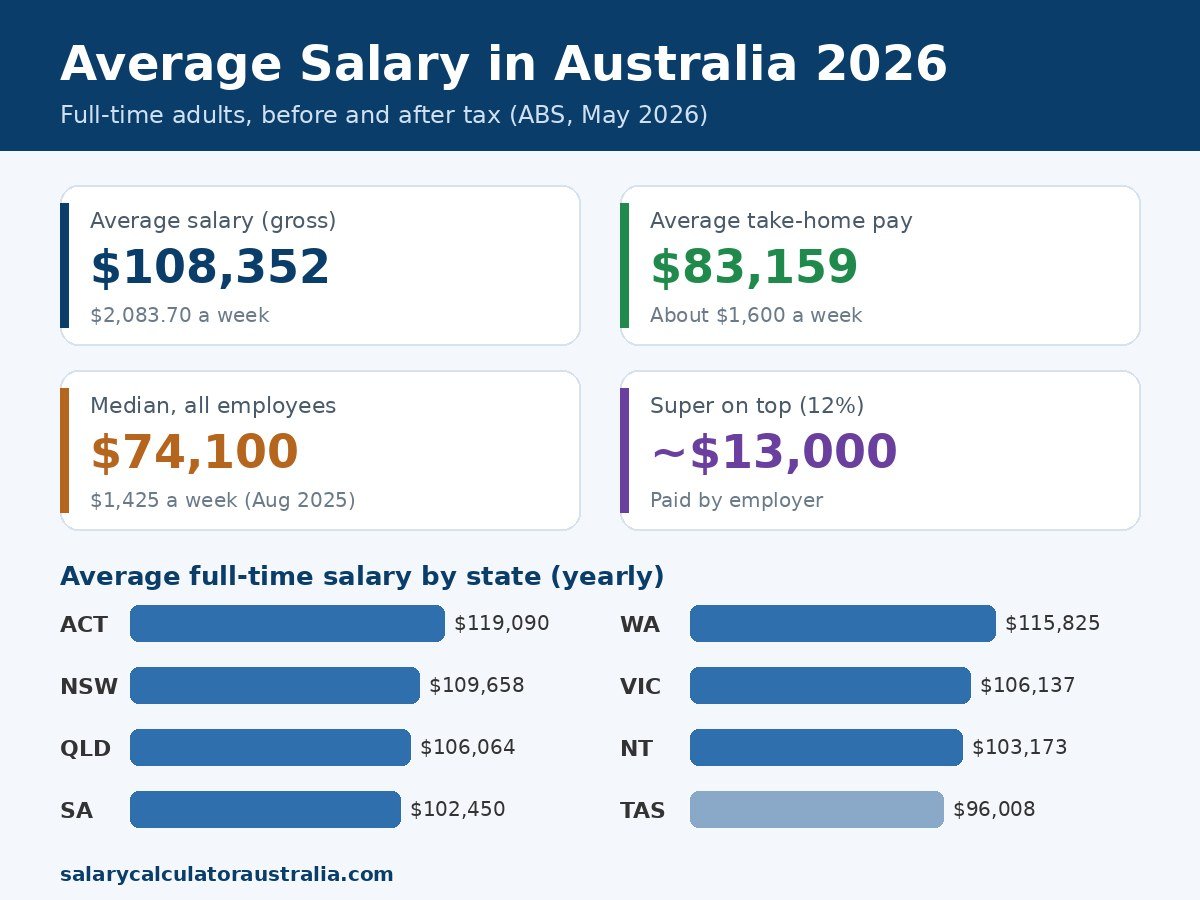
The average full-time salary in Australia is about $108,350 a year, or $2,083.70 a week, before tax. That’s the latest ABS figure for full-time adults (May 2026). After income tax and the Medicare levy, it works out to roughly $83,160 a year, or about $1,600 a week in your pocket.
But the “average” is pulled up by high earners. The typical (median) worker earns much less, around $1,425 a week across all employees. This guide explains both numbers, shows what people earn by state, industry, and gender, and helps you work out where your own pay sits.
Average salary in Australia: the key numbers
| Measure | Weekly | Yearly (×52) |
|---|---|---|
| Full-time adult ordinary earnings (average) | $2,083.70 | $108,352 |
| Full-time adult total earnings (incl. overtime) | $2,156.50 | $112,138 |
| All employees, total earnings (incl. part-time) | $1,579.20 | $82,118 |
| Median earnings, all employees (Aug 2025) | $1,425 | $74,100 |
Each line measures something different, which is why you’ll see very different “average salary” figures online:
- Full-time ordinary earnings is the number most people mean by “average salary.” It covers full-time adults and leaves out overtime.
- Total earnings adds overtime, so it’s a bit higher.
- All employees includes part-time and casual workers, so it’s much lower.
- Median is the middle worker: half earn more, half earn less. It’s the best guide to a “normal” pay packet.
Average vs median salary: which one should you use?
Use the median if you want to know what a typical person earns. Use the average if you’re comparing against official statistics or news reports.
The average is higher because a small group of very high earners lifts it. Picture ten people in a room. Nine earn $70,000 and one earns $500,000. The average is $113,000, but nobody in the room earns anything close to that. The median is $70,000, which describes the room much better.
That’s why many people feel “below average” when they’re actually right in the middle. If you earn around $75,000 to $85,000, you’re close to what a typical Australian employee earns.
Average salary after tax
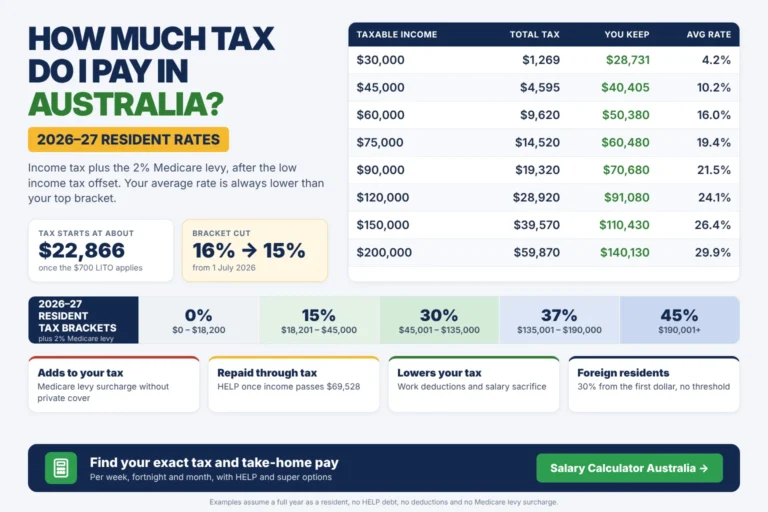
Here’s what the main figures look like after 2026–27 income tax, the low income tax offset where it applies, and the 2% Medicare levy. These assume you’re an Australian resident, claim the tax-free threshold, and have no HELP debt.
| Gross salary | Tax + Medicare | Take-home per year | Per week | Per fortnight |
|---|---|---|---|---|
| $74,100 (median) | $14,232 | $59,868 | $1,151 | $2,303 |
| $82,200 | $16,824 | $65,376 | $1,257 | $2,514 |
| $100,000 | $22,520 | $77,480 | $1,490 | $2,980 |
| $108,352 (average) | $25,193 | $83,159 | $1,599 | $3,198 |
| $120,000 | $28,920 | $91,080 | $1,752 | $3,503 |
| $150,000 | $39,570 | $110,430 | $2,124 | $4,247 |
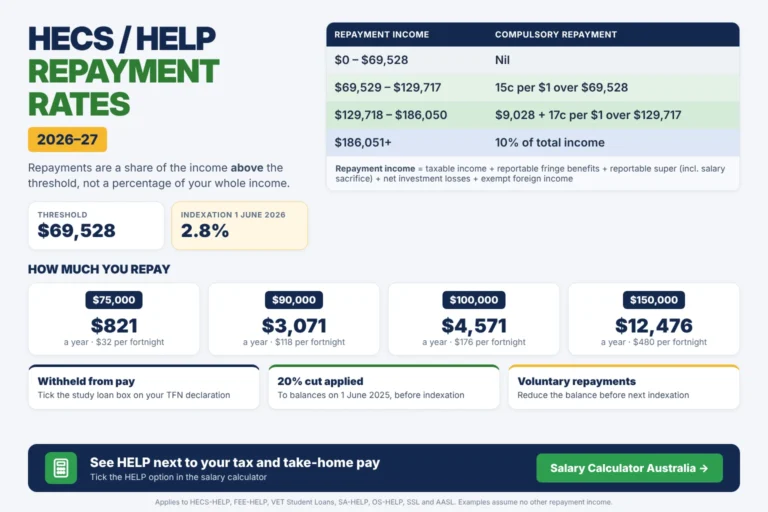
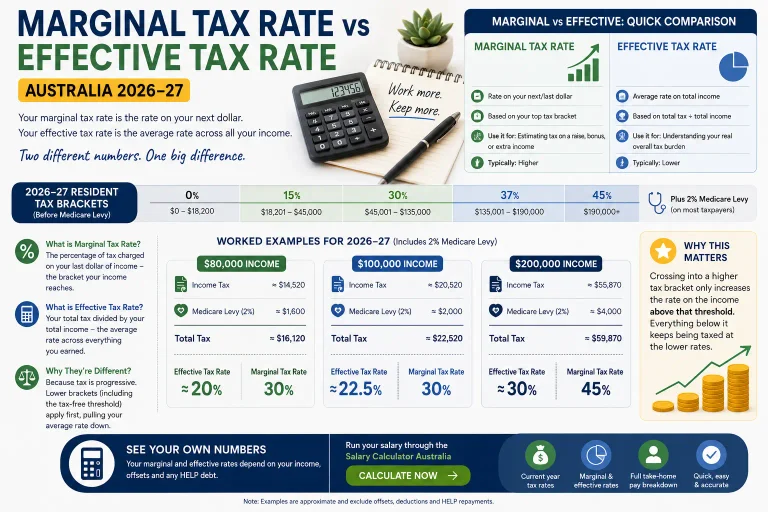
On the average full-time salary, about 23% of your pay goes to tax and Medicare. That’s your effective tax rate. Your marginal rate (the tax on each extra dollar) is higher, at 30% plus 2% Medicare. If those two terms are confusing, our guide on marginal vs effective tax rates explains the difference with examples.
To see your exact figure, including HELP repayments or salary sacrifice, put your own salary into the take-home pay calculator on our homepage.
Don’t forget super
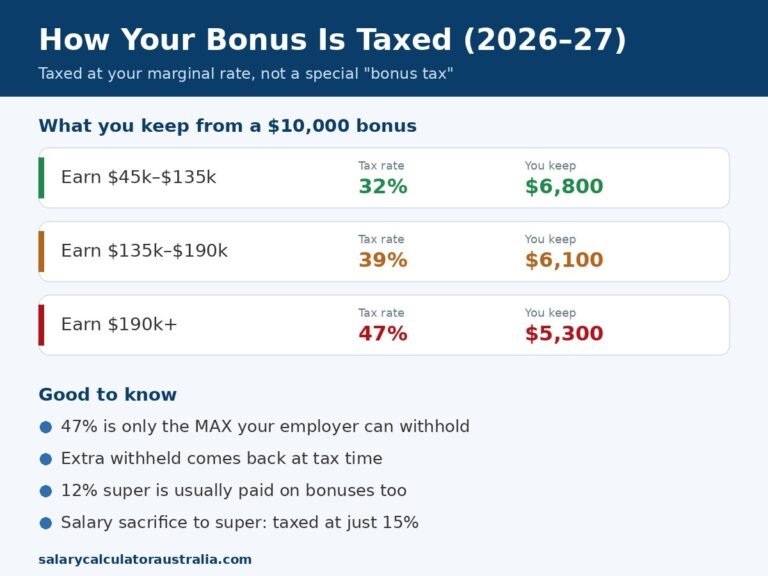
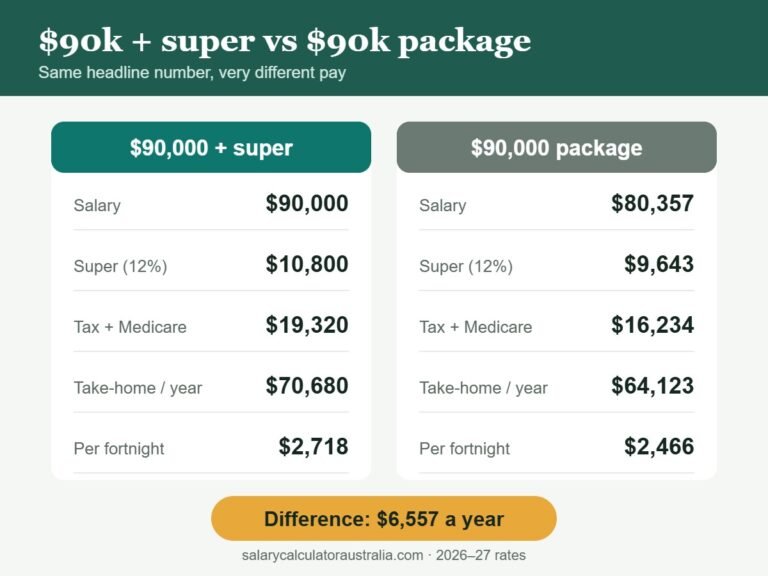
Super is paid on top of your salary at 12%. On the average full-time salary of $108,352, your employer adds about $13,000 a year to your super fund. If a job ad quotes a “package” instead, super may already be inside that number. Our guide to reading “salary plus super” vs package offers shows how to tell.
Average salary by state and territory
Full-time adult ordinary earnings, May 2026:
| State or territory | Weekly | Yearly |
|---|---|---|
| ACT | $2,290.20 | $119,090 |
| Western Australia | $2,227.40 | $115,825 |
| New South Wales | $2,108.80 | $109,658 |
| Australia (all) | $2,083.70 | $108,352 |
| Victoria | $2,041.10 | $106,137 |
| Queensland | $2,039.70 | $106,064 |
| Northern Territory | $1,984.10 | $103,173 |
| South Australia | $1,970.20 | $102,450 |
| Tasmania | $1,846.30 | $96,008 |
Why the ACT is on top: Canberra has a large share of federal public servants, and public sector pay is higher on average. Public sector workers averaged $2,263 a week, compared with $2,034 in the private sector.
Why WA is second: mining. Big mining wages lift the whole state’s average, especially for men. Male full-time workers in WA average $2,378.70 a week, the highest of any state.
Why Tasmania is lowest: a smaller economy with fewer high-paying industries like mining, finance, and head-office jobs.
Remember that living costs matter as much as pay. A slightly lower salary in Adelaide or Hobart can go further than a higher one in Sydney once you pay rent.
Average salary by industry
Full-time adult ordinary earnings by industry, May 2026 (yearly figures are weekly × 52, rounded):
| Industry | Weekly | Yearly |
|---|---|---|
| Mining | $3,224.20 | $167,700 |
| Information media and telecommunications | $2,714.10 | $141,100 |
| Electricity, gas, water and waste | $2,546.00 | $132,400 |
| Professional, scientific and technical | $2,389.60 | $124,300 |
| Financial and insurance services | $2,341.30 | $121,700 |
| Education and training | $2,197.90 | $114,300 |
| Public administration and safety | $2,179.80 | $113,300 |
| Health care and social assistance | $2,037.20 | $105,900 |
| Transport, postal and warehousing | $2,032.30 | $105,700 |
| Construction | $1,985.30 | $103,200 |
| Wholesale trade | $1,982.90 | $103,100 |
| Rental, hiring and real estate | $1,979.60 | $102,900 |
| Administrative and support services | $1,950.00 | $101,400 |
| Arts and recreation | $1,877.40 | $97,600 |
| Manufacturing | $1,843.10 | $95,800 |
| Other services | $1,621.70 | $84,300 |
| Retail trade | $1,581.60 | $82,200 |
| Accommodation and food services | $1,509.90 | $78,500 |
Mining pays more than double what hospitality pays. But industry averages hide a lot. A mining camp cook and a mine engineer are both counted under “mining.” Your role, experience, and location usually matter more than the industry label.
Average salary for men and women
Full-time men average $2,181.00 a week ($113,412 a year). Full-time women average $1,934.50 a week ($100,594 a year). That’s a gap of $246.50 a week, or about 11.3%.
The good news is that the gap is slowly shrinking. Women’s full-time earnings grew 3.8% over the year, faster than men’s 3.5%. The ABS notes that these raw figures don’t adjust for occupation or hours worked, which explain part of the difference.
Across all employees (including part-time), the gap looks much bigger: $1,832.80 a week for men vs $1,336.00 for women. That’s mostly because more women work part-time.
How fast are wages growing?
Full-time ordinary earnings rose 3.7% in the year to May 2026. The ABS noted this was the slowest growth since 2022. Inflation has also cooled, so most workers are now seeing small real pay rises after the cost-of-living squeeze of 2022 and 2023.
If you haven’t had a pay rise in the last 12 months, you’ve likely gone backwards compared with the market. That’s useful information to bring to your next salary review.
Is my salary good? A quick way to check
Here’s a rough guide based on full-time pay in 2026:
- Under $65,000: below the typical full-time wage. Common for entry-level, retail, and hospitality roles.
- $65,000 to $90,000: around the middle. This is where most full-time workers sit.
- $90,000 to $120,000: above the median and around the full-time average.
- $120,000 to $180,000: well above average, roughly the top 15% to 20% of earners.
- Over $180,000: top 5% to 10% of income earners.
Compare against your own state and industry, not just the national number. $95,000 is a strong salary in retail in Tasmania, but below average for an engineer in Perth.
How to convert your pay to compare it
Pay is quoted in different ways, so convert everything to the same basis before you compare:
- Weekly to yearly: multiply by 52. $1,500 a week is $78,000 a year.
- Fortnightly to yearly: multiply by 26.
- Hourly to yearly: multiply by 38 hours, then by 52. $45 an hour is about $88,920 a year.
- Part-time to full-time: divide your pay by your hours, then multiply by 38.
Our salary to hourly converter does these sums for you. If you work reduced hours, the pro-rata salary tool shows your full-time equivalent. For weekly or fortnightly take-home pay, use the weekly pay after tax or fortnightly calculator.
Ways to lift your take-home pay
You can’t control the national average, but you can control a few things that change your own result:
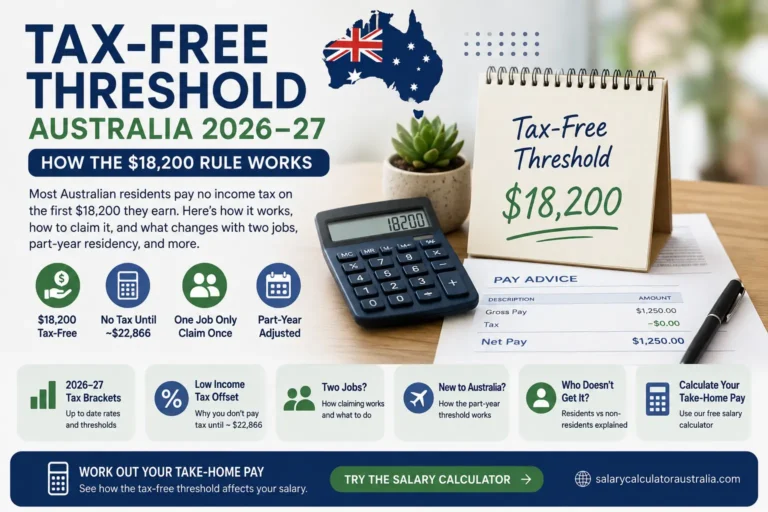
- Check your tax withholding. Claim the tax-free threshold on one job only. Two jobs often leads to a bill, as explained in our second job tax guide.
- Look at salary sacrifice. Putting extra pre-tax pay into super can cut your tax. Run the numbers with the salary sacrifice calculator.
- Know your gross vs net. Negotiate on gross salary, but budget on net. Our explainer on gross and net income covers the difference.
- Check your payslip. Mistakes in hours, rates, or super happen more than you’d think. Here’s how to check a payslip line by line.
Where these numbers come from
The averages in this guide come from the ABS Average Weekly Earnings release for May 2026, published in August 2026. The median comes from the ABS Employee Earnings survey for August 2025. Take-home figures use the 2026–27 resident tax rates, the low income tax offset, and the 2% Medicare levy. We update this page when the ABS releases new figures, usually every six months.
Common questions
What is the average salary in Australia in 2026?
The average full-time salary in Australia is about $108,350 a year ($2,083.70 a week) before tax, based on ABS data for May 2026. Including overtime, it’s about $112,140.
What is the average salary in Australia after tax?
On the average full-time salary of about $108,350, take-home pay is roughly $83,160 a year, or about $1,600 a week, after 2026–27 income tax and the Medicare levy.
What is the median salary in Australia?
Median weekly earnings for all employees were $1,425 in August 2025, or about $74,100 a year. Full-time men had a median of $1,841 a week and full-time women $1,631.
Which state has the highest average salary?
The ACT has the highest full-time average at $2,290.20 a week (about $119,090 a year), followed by Western Australia at $2,227.40. Tasmania is the lowest at $1,846.30.
Which industry pays the most in Australia?
Mining pays the most, averaging $3,224.20 a week (about $167,700 a year) for full-time adults. Accommodation and food services pays the least at $1,509.90 a week.
Is $100,000 a good salary in Australia?
Yes. $100,000 is well above the median wage and close to the full-time average. After tax and Medicare, it’s about $77,480 a year, or $1,490 a week.
How much super is paid on the average salary?
Super is paid at 12% on top of your salary. On $108,352, that’s about $13,000 a year paid into your super fund by your employer.