How Is a Bonus Taxed in Australia? 2026–27 Guide
Written by: Salary Calculator Australia Editorial Team · Fact-checked against: ATO 2026–27 tax rates, ATO Schedule 5 withholding rules and super contribution caps · Last reviewed: October 2026
A bonus in Australia is taxed as ordinary income at your marginal tax rate, just like your salary. There is no special “bonus tax.” What confuses people is the amount your employer withholds from the bonus payment, which can look much higher than your normal tax. Withholding is capped at 47% of the bonus, and anything taken above the tax you actually owe comes back to you when you lodge your tax return.
This guide explains how your bonus is really taxed in 2026–27, why the payslip can look scary, how much you’ll actually keep, and the smart moves (like putting your bonus into super) that can reduce the tax.
The short version
- Your bonus is added to your income for the year and taxed at your marginal rate (plus the 2% Medicare levy).
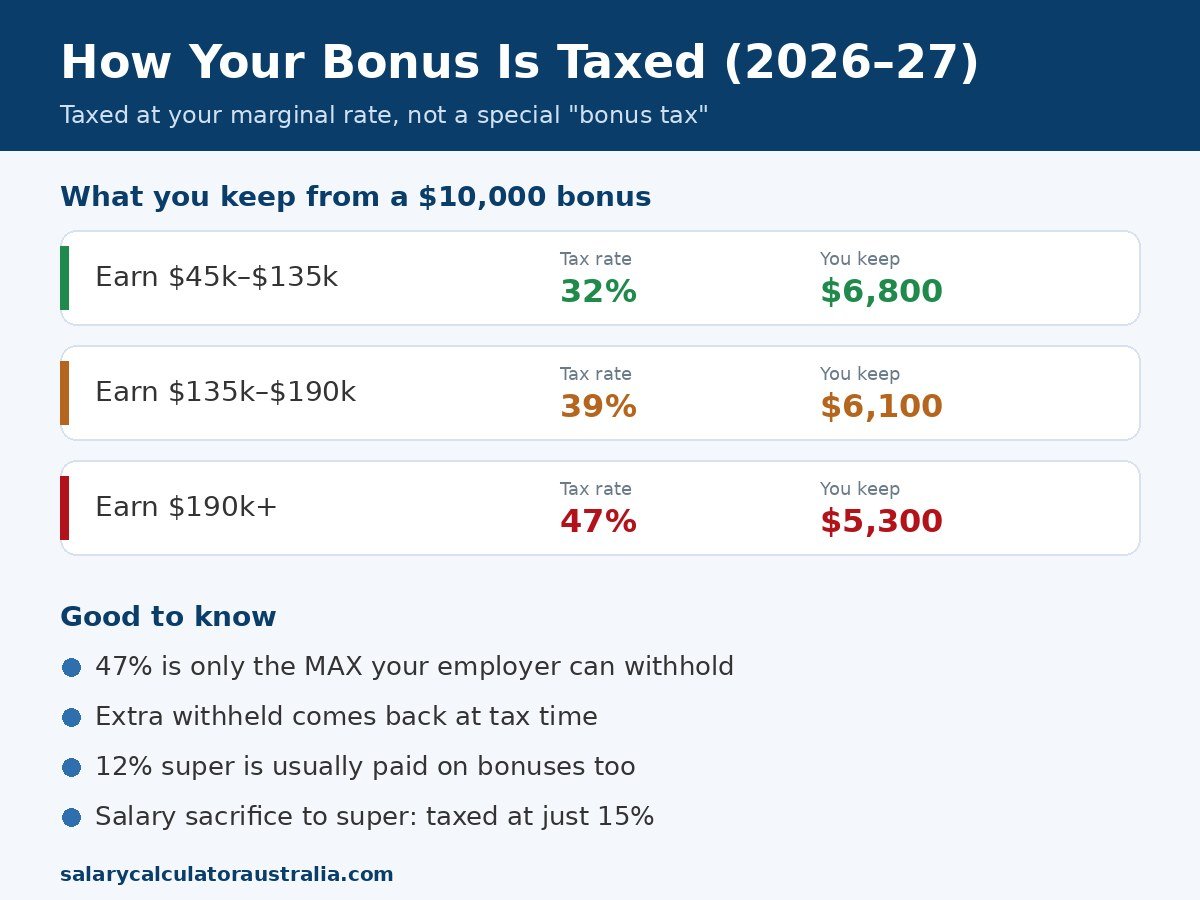
- Most people earning $45,001–$135,000 pay 32 cents in the dollar on a bonus (30% tax + 2% Medicare).
- Your employer may withhold more than that on the day. It is not a higher tax rate. It’s just an estimate.
- Any extra withheld is refunded at tax time. Too little withheld means a bill.
- Super is usually paid on top of a bonus (12%).
2026–27 tax rates that apply to your bonus
| Taxable income | Tax rate on each extra dollar | With 2% Medicare |
|---|---|---|
| $0 – $18,200 | 0% | 0% |
| $18,201 – $45,000 | 15% | 17% |
| $45,001 – $135,000 | 30% | 32% |
| $135,001 – $190,000 | 37% | 39% |
| $190,001 and over | 45% | 47% |
Your bonus is taxed at the rate for the bracket(s) it falls into. If you’re not sure which rate is your “marginal” rate versus the average you actually pay, our explainer on marginal vs effective tax rates walks through it.
How much of my bonus will I keep?
Here’s what you actually keep after tax and Medicare (2026–27, resident, no HELP debt):
| Base salary | Bonus | Tax + Medicare on bonus | You keep | Effective rate on bonus |
|---|---|---|---|---|
| $60,000 | $5,000 | $1,675 | $3,325 | 33.5% |
| $85,000 | $10,000 | $3,200 | $6,800 | 32% |
| $130,000 | $10,000 | $3,550 | $6,450 | 35.5% |
Notice the $130,000 example. Only the part of the bonus above $135,000 is taxed at the higher 37% rate. The first $5,000 is still taxed at 30%. A bonus never makes your whole salary taxed at a higher rate. That is one of the most common myths.
Why the tax on my bonus payslip looks so high
Your employer doesn’t know your final income for the year, so it uses ATO rules to estimate the tax. How the bonus is paid makes a big difference.
If the bonus is paid in a separate payment (Method A)
For a bonus that covers several pay periods (like an annual or quarterly bonus), employers usually follow the ATO’s Schedule 5 “Method A.” In simple terms:
1. They spread the bonus across the year’s pay periods (for example, divide by 26 for fortnightly pay).
2. They work out how much extra tax that adds to each normal pay.
3. They multiply back up to get the tax on the whole bonus.
4. The result is capped at 47% of the bonus.
This lands very close to your real marginal rate. On an $85,000 salary, a $10,000 annual bonus would have about $3,200 withheld, which matches the tax you’ll actually owe.
If the bonus is lumped into your normal pay
Some payroll systems simply add the bonus to that week’s or fortnight’s pay. The tax table then treats you as if you earn that much every pay, all year.
Example: fortnightly pay of $3,269 ($85,000 a year) plus a $10,000 bonus in the same pay. The tax table treats that $13,269 fortnight as if you earn about $345,000 a year. Withholding on the bonus jumps to roughly $4,240 (about 42%), instead of $3,200.
You haven’t lost that extra $1,040. It’s counted as tax already paid, and it comes back as part of your refund when you lodge. If you want to understand why refunds happen, see our guide on why you get a refund or a bill.
Is there a 47% bonus tax?
No. 47% is only the maximum an employer can withhold from a bonus under the ATO’s withholding rules, matching the top tax rate plus Medicare. Unless you earn over $190,000, your real tax on the bonus will be lower.
Do I get super on my bonus?
Usually, yes. Most bonuses (performance, sign-on, retention and discretionary bonuses) count as ordinary time earnings, so your employer must pay 12% super on top. The main exception is a bonus that relates only to overtime hours.
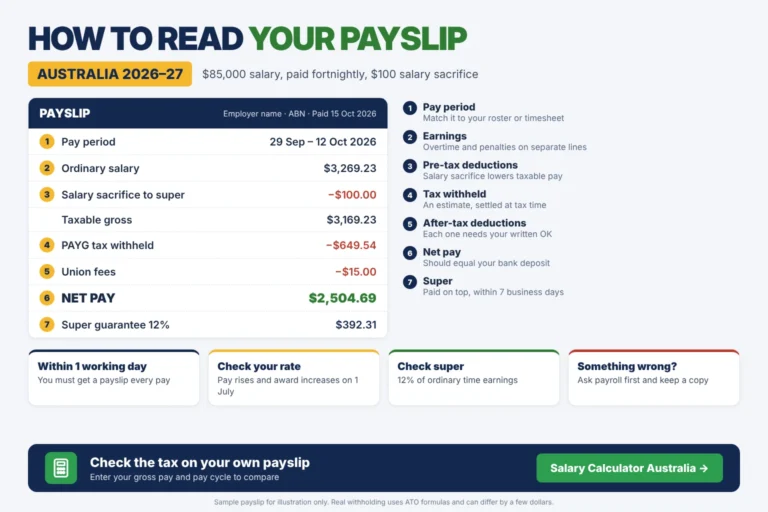
Since 1 July 2026, employers have to pay super within seven days of payday (“Payday Super”), so the super on your bonus should land in your fund soon after the bonus itself. Check your super account. Missing super on bonuses is a common payroll mistake. Here’s how to check your payslip line by line.
Can I put my bonus into super to pay less tax?
Yes, through salary sacrifice. Instead of taking the bonus as cash, you ask your employer to pay some or all of it into your super. Contributions are taxed at 15% inside super, instead of your marginal rate of 32%–47%.
On a $10,000 bonus at the 32% rate:
- Taken as cash: you keep about $6,800.
- Sacrificed into super: about $8,500 goes into your super (after 15% contributions tax).
Three rules to know:
1. Timing matters. The arrangement must be in place before you become entitled to the bonus, not just before it’s paid. Ask payroll early.
2. Watch the cap. The concessional contributions cap for 2026–27 is $32,500, and it includes your employer’s 12% super. Going over means extra tax.
3. You can’t touch it until retirement. It’s a great tax move, but only for money you won’t need soon.
Run the numbers on your own salary with the salary sacrifice calculator.
Bonuses and HELP debt
If you have a HELP (or other study loan) debt, your employer also withholds extra for HELP repayments from the bonus, because the bonus increases your repayment income. Your final HELP repayment is worked out at tax time based on your total income. See the current HELP repayment thresholds and rates.
Other things a bonus can affect
- Medicare levy surcharge: a bonus can push your income above the MLS threshold if you don’t have private hospital cover.
- Government payments: Centrelink and family payments may be reduced because your income is higher.
- Tax offsets: the low income tax offset phases out as your income rises.
Quick checklist when you get a bonus
1. Check how much tax was withheld and whether it looks like your marginal rate.
2. Check that 12% super was paid on it.
3. If you have a HELP debt, expect a bit more withheld.
4. If a lot was withheld, expect a bigger refund at tax time.
5. Planning ahead for next year’s bonus? Talk to payroll about salary sacrifice before you earn it.
Want to see your normal take-home pay first? Use our free pay calculator to see your weekly, fortnightly and monthly pay after tax.
Common questions
How much tax do I pay on a bonus in Australia?
A bonus is taxed at your marginal rate plus 2% Medicare. For most people earning $45,001 to $135,000, that’s 32 cents in the dollar. On a $10,000 bonus, you’d keep about $6,800.
Is a bonus taxed at 47% in Australia?
No. 47% is only the maximum an employer can withhold from a bonus. Your actual tax depends on your income. Unless you earn over $190,000, it will be lower, and any extra withheld is refunded at tax time.
Why was so much tax taken out of my bonus?
Your employer estimates the tax. If the bonus was added to a normal pay, the tax table treats it as if you earn that much every pay, so more is withheld. The extra comes back when you lodge your tax return.
Do I get super on my bonus?
Usually yes. Most bonuses count as ordinary time earnings, so your employer must pay 12% super on them. Bonuses relating only to overtime are the main exception.
Can I salary sacrifice my bonus into super?
Yes, if the arrangement is set up before you become entitled to the bonus. It’s taxed at 15% in super instead of your marginal rate, but it counts toward the $32,500 concessional cap for 2026–27.
Does a bonus push me into a higher tax bracket?
Only the part of the bonus above the bracket threshold is taxed at the higher rate. The rest of your income is taxed exactly the same as before.
Will my bonus affect my HELP repayments?
Yes. A bonus increases your repayment income, so more is withheld for HELP and your final repayment at tax time may be higher.